
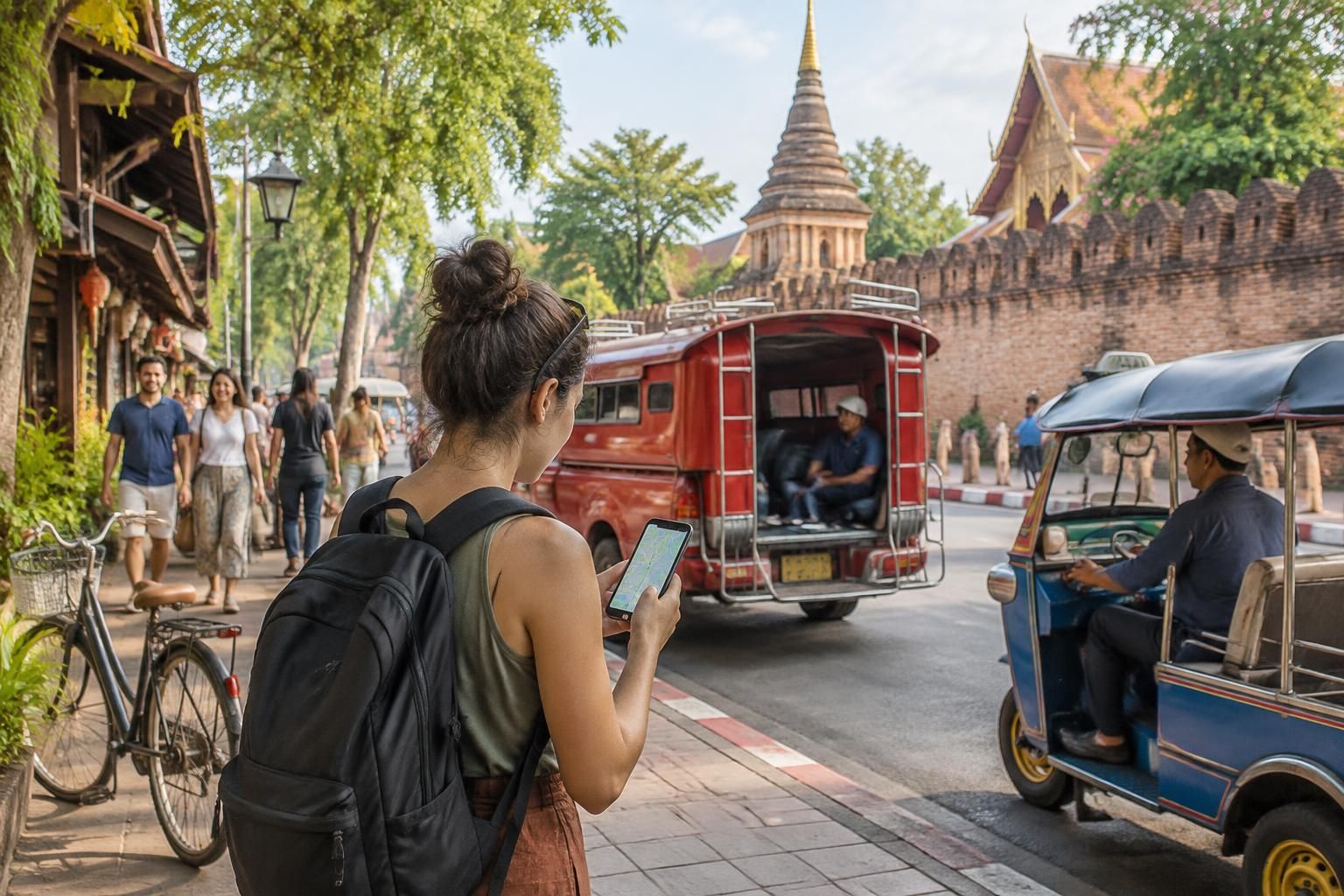
Chiang Mai rewards travelers who slow down enough to notice its lanes, temple walls and market stalls—but a pleasant walk can become a tiring one when heat, traffic or luggage enters the picture. The city’s transport is a patchwork rather than a single network: red shared trucks serve many short journeys, ride-hailing makes door-to-door trips easier, and buses and trains connect the northern capital with destinations farther afield.
A little planning makes that patchwork easier to use. A visitor staying near the Old City moat might walk between temples in the morning, share a Songthaew across town for lunch and book Grab after an evening market. Someone based in Nimman may make different choices, while a traveler with limited mobility may need a prearranged vehicle from the start. The aim is not to use one perfect mode for every trip, but to choose a comfortable, responsible option for each journey.
At a glance
- Walk or cycle for short daytime trips, particularly within the Old City.
- Use a shared red truck for flexible, locally operated journeys; confirm the destination and fare before boarding.
- Choose an app-booked ride or arranged transfer for luggage, late arrivals and time-sensitive trips.
- Check current bus and train schedules before booking, especially for onward journeys.
- Allow for heat, rain, smoke and uneven pavements when planning the day.
Walking and Bicycle Rental in Chiang Mai: Choosing a Convenient Base
Where a visitor sleeps shapes the transport budget more than it might first appear. A room close to the places on the day’s itinerary can turn several paid rides into short, enjoyable journeys on foot, leaving more time for the city itself.
The Old City, framed by its moat and sections of historic wall, is a practical base for temple visits and first-time exploration. Narrow lanes connect restaurants, guesthouses and monasteries, and several clusters of sights are close enough to combine in one morning without hurrying.
Nimmanhaemin, often shortened to Nimman, suits visitors who want cafés, contemporary shops and a lively evening scene nearby. The Riverside and Night Bazaar areas offer another atmosphere, with riverside dining and market access, though a stay there can mean more cross-town trips for Old City temples.
Walking Between Chiang Mai Temples and Markets
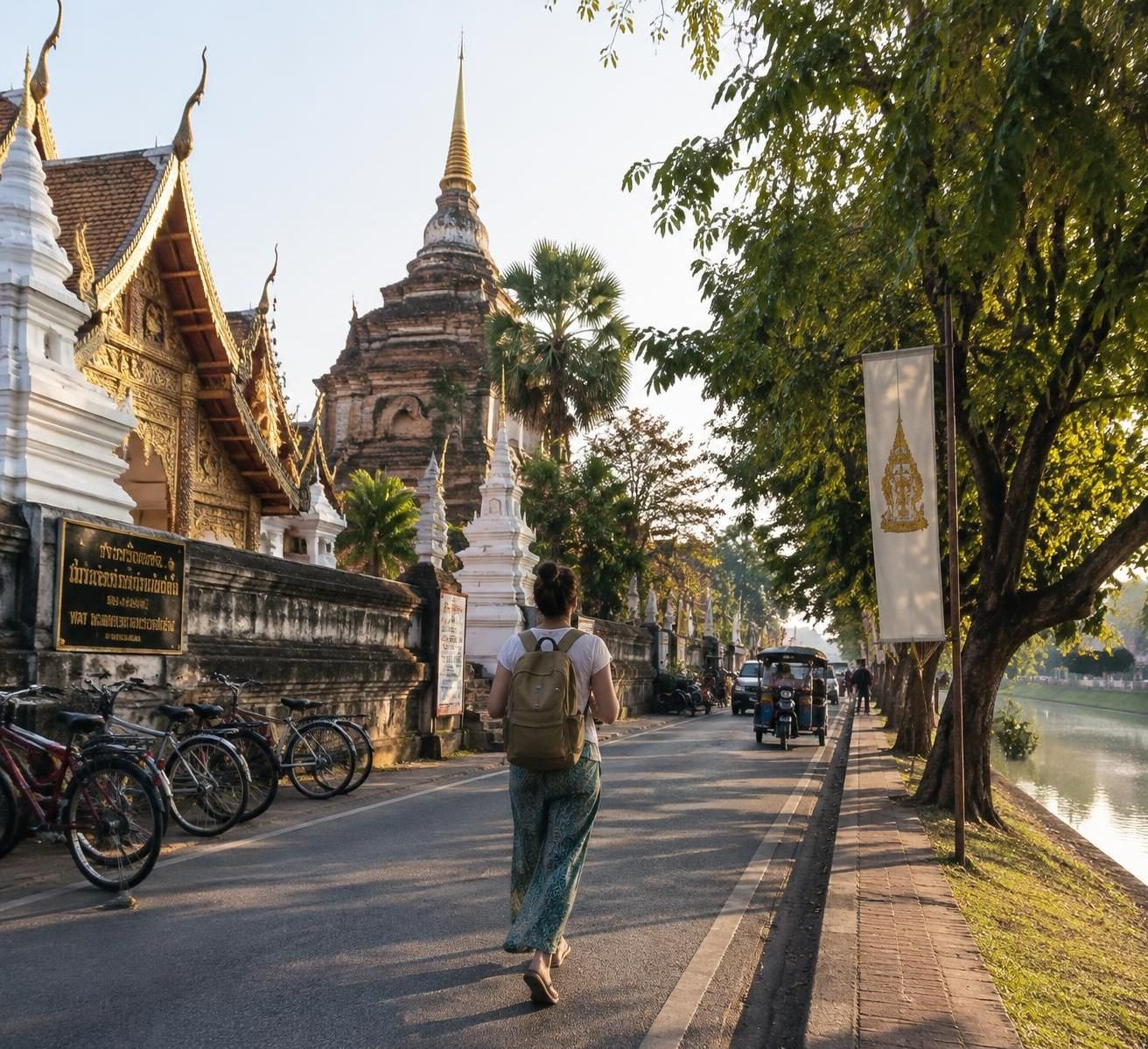
Walking gives travelers time to notice details that disappear from a vehicle window: a quiet courtyard, a small noodle shop or a neighborhood shrine. A route linking Wat Phra Singh, Wat Chedi Luang and nearby lanes can be broken up with shaded stops rather than treated as a race between attractions.
Consider Maya, a fictional visitor spending three days in town. By choosing a guesthouse within the moat, she can visit a temple early, return to rest when the heat rises and head out again for dinner without arranging transport for every leg.
Even short distances deserve attention. Pavements can be narrow, broken or blocked, and motorcycles may approach quickly at crossings; use marked crossings where available, look carefully in both directions and avoid assuming that a driver will stop.
The weekend walking streets change how central roads function. Saturday’s market along Wualai Road and Sunday’s market along Ratchadamnoen Road bring crowds and vehicle restrictions, so arrange a pickup on a nearby open street rather than expecting a driver to reach a stall in the middle of the market.
Bicycle Rental for Short Chiang Mai Journeys
Bicycle rental is useful for travelers who want to cover more ground while still stopping spontaneously. Local shops and some guesthouses rent bikes; before paying, test the brakes, tires, lights and lock, and ask what happens if the bicycle is damaged or stolen.
Choose a comfortable, correctly sized bicycle and carry water, sun protection and a map that works without a mobile signal. Morning rides are generally easier than hot afternoons, and quieter back streets are more relaxing than the busy roads around the moat.
Crossing those larger roads can be the hardest part of an otherwise gentle ride. If a junction feels intimidating, dismount and cross on foot when safe; a slower route through residential streets can be more enjoyable than a direct one competing with fast-moving vehicles.
An e-bike may make longer distances more manageable, but the rental agreement should explain battery range, charging and local rules. For hills or trails, a specialist operator can provide suitable equipment and explain the difficulty rather than sending an inexperienced rider uphill on an ordinary city bike.
Travelers with mobility or balance concerns should assess a route in person where possible, since flat ground does not guarantee smooth pavements. A convenient base reduces pressure to cover long distances and makes it easier to save shared transport for the journeys that genuinely need it.
Songthaew, Tuk-tuk and Local Buses: Shared Transport in Chiang Mai
Red covered pickup trucks are among Chiang Mai’s most recognizable forms of transport. Known locally as rot daeng and widely called songthaews, they generally pick up people traveling in a similar direction rather than following a rigid citywide timetable.
For a traveler without a car, that flexibility is valuable. It also means the first conversation with the driver matters: the destination, price and type of ride should be clear before anyone climbs into the back.
How to Take a Shared Songthaew
Stand somewhere safe on a main road and signal an approaching red truck. Tell the driver the destination using a familiar landmark, a map pin or the name written in Thai; a driver may decline if the stop does not fit the direction of travel, which is normal rather than a reason to worry.
Ask whether the quoted amount is for a shared ride or a private charter. A charter can cost more because the driver is taking the group directly, while a shared journey may involve collecting or dropping off other passengers along the way.
For example, Maya wants to travel from the Old City toward a market. She shows the driver the market name, confirms the fare per person and boards only once both understand the arrangement; she keeps small notes ready for payment at the end.
For destinations outside the center, a truck already heading along the relevant outbound road may be easier to find than one traveling in the opposite direction. Allow extra time, since the driver’s route depends partly on the other passengers and a shared ride is not always a direct one.
Board carefully using the rear step and hold the handrail, particularly in rain. The open-sided seating may not suit everyone, and travelers with large bags or difficulty climbing into the vehicle may prefer a booked car or an accessible transfer arranged in advance.
Tuk-tuks, Rickshaws and Local Buses
A Tuk-tuk is usually hired for a private trip rather than shared like a red truck. It can be a memorable short ride, but agree on the total price and exact destination before getting in, especially if several passengers are traveling together.
If a driver proposes an unexpected shopping stop, travelers can politely decline and repeat the intended destination. Around Warorot Market, traditional cycle rickshaws, known as samlor, offer a slower local experience where available; agree on the route and price before departure.
Local buses can offer an affordable alternative on corridors that match the itinerary, but routes, frequencies, payment methods and airport links can change. Check current operator information or ask at a staffed transport counter rather than relying on an old map or assuming a bus will arrive frequently.
The following comparison is useful when deciding what to try first. Fares are intentionally left for travelers to confirm because a private quote, a shared seat and an app fare are not interchangeable.
| Option | Best suited to | Before setting off |
|---|---|---|
| Shared red truck | Flexible trips with light luggage | Confirm destination, fare and shared status |
| Tuk-tuk | Short private journeys | Agree on the total price and route |
| City bus | Trips along an operating route | Check current stops, service times and payment |
| App-booked car | Door-to-door trips and luggage | Check pickup point, fare and vehicle details |
Courtesy makes these exchanges easier: a greeting, a clear destination and a calm response to a refusal are usually more useful than determined bargaining. Understanding the difference between a shared seat and a private ride also prepares travelers to compare these vehicles with app-based transport.
Grab and Airport Transfers in Chiang Mai: Arrivals, Luggage and Late Nights
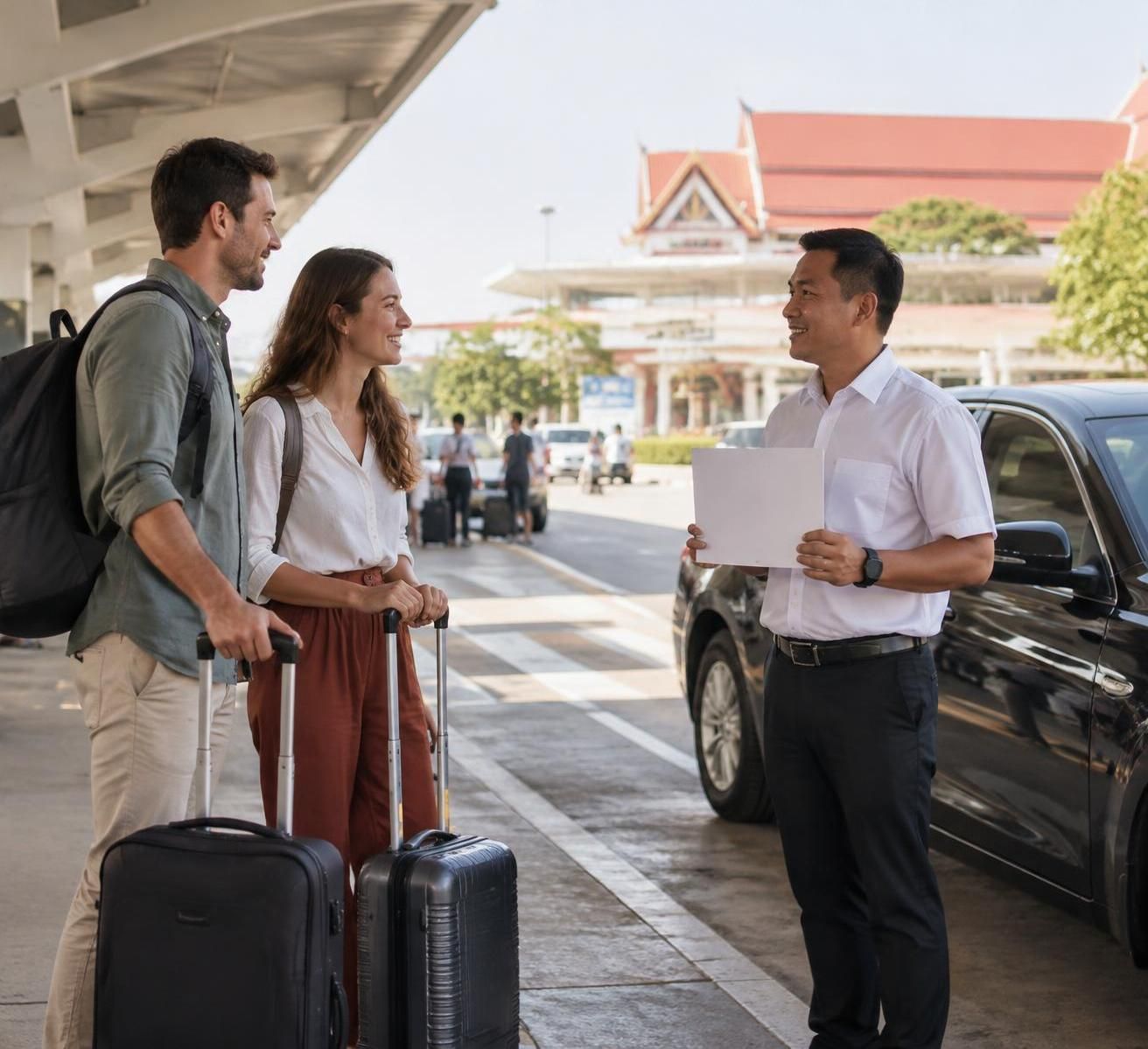
After a flight, the most welcome transport option is often the one that removes uncertainty. Airport transfers arranged through an official taxi counter, a reputable accommodation provider or a ride-hailing app can take visitors directly to their accommodation without a negotiation on a busy roadside.
Chiang Mai International Airport is relatively close to central neighborhoods, but journey time varies with the destination and road conditions. Rather than promising a particular number of minutes, leave a buffer for collecting bags, finding the correct pickup point and dealing with traffic.
Getting From Chiang Mai Airport to the Old City
On arrival, Maya has a suitcase, a tired travel companion and an address on her phone. An official airport taxi or a booked car is a sensible choice because the fare or booking details can be checked before departure and the vehicle can stop near the guesthouse entrance.
At the airport, follow the current signs for licensed taxis or ask staff at an official counter. If using an app, check its instructions for the designated pickup area, since airport procedures and meeting points may change.
Before accepting a transfer, confirm whether the quoted amount covers the whole vehicle, the destination, luggage and any stated charges. A prebooked service should provide the driver’s meeting instructions and a contact number; keep these available offline in case airport Wi-Fi is unreliable.
Red trucks may also be available around the airport, but travelers should ask about the destination and total cost rather than assume that an airport departure will be priced like a shared city trip. For a group, a larger vehicle may be more comfortable than squeezing several cases into a smaller car.
For the return journey, arrange the ride with enough time for the airline’s check-in requirements as well as the drive. Early flights, holidays and the busy cool season are good reasons to reserve ahead and confirm the pickup with the provider the day before.
Using Grab and Other Ride-Hailing Services
Grab is useful when a clear pickup point and door-to-door travel matter, especially after dark or when rain arrives suddenly. Availability, vehicle types and quoted prices depend on demand, so check the app before making a time-sensitive plan.
Enter the destination carefully and inspect the map pin. A hotel name can resemble another business name, and narrow lanes or market closures may require the driver to stop around the corner; sending a nearby landmark can prevent a frustrating wait.
Before boarding, match the registration number and vehicle details shown in the app. Check the accepted payment method, keep the phone charged and share trip details with a trusted contact when that feels appropriate.
For late-night pickups, wait in a well-lit place rather than standing alone on a dark side street. If a walking street is closed, move to an accessible road and tell the driver where the group is waiting.
Travelers who prefer a human point of contact can ask their accommodation to book a licensed local driver. For additional context on planning time in Chiang Mai, build transfer time into the day rather than treating it as an afterthought.
Convenience does not require a private vehicle for every outing. Using an arranged ride for the difficult arrival or late return leaves more flexibility to walk or share transport when the conditions are comfortable.
Scooter Rental, Traffic and Seasonal Safety Without a Car
A scooter can make outlying places feel more accessible, but it also places the rider directly in Chiang Mai’s road environment. For visitors without recent riding experience, hiring a driver or joining a small group is often a more comfortable choice than learning on unfamiliar streets.
Scooter rental is not a requirement for seeing the city. Maya, for example, can reach central sights by walking and shared transport, then choose a driven trip for a mountain excursion rather than taking on a winding road she has never ridden before.
Licenses, Insurance and a Safe Rental Check
Anyone considering a motorcycle should check the licensing requirements that apply to their nationality and the vehicle. A car-only license is not a substitute for motorcycle authorization; carry the appropriate home license, any required international driving permit and identification.
Insurance needs equally careful attention. Ask the rental business what its policy covers, then read the travel insurer’s conditions for motorcycle riding, including licensing, engine size, medical treatment and third-party liability.
A cheap rental is poor value if the rider is left responsible for a serious collision. If coverage is unclear or the documents cannot be inspected, choose another provider or another mode of transport.
Before accepting a bike, test both brakes, lights, indicators, horn and tires, and photograph existing damage in the operator’s presence. Ask about fuel, breakdown assistance, return conditions and the deposit; seek an alternative to leaving an original passport whenever possible.
Both rider and passenger need a properly fitting helmet. Avoid riding after drinking, do not use a phone while moving, and remember that Thailand drives on the left; unfamiliar junctions deserve more attention than a quick glance at a navigation screen.
Traffic around the moat and on larger roads can be intense, while mountain routes add bends, steep sections and changing weather. A route that looks short on a map may be demanding in practice, particularly for someone carrying a passenger.
Heat, Rain, Smoke and Accessible Route Planning
Season affects how much a traveler can comfortably do outside. In the cooler, busier months from roughly November to February, advance booking helps with popular transfers and excursions; from March to May, heat makes early departures especially useful.
During the rainy season, generally around June to October, a clear morning can give way to a heavy afternoon shower. Carry a light waterproof layer, protect electronics and allow extra time rather than rushing across slippery roads to make a connection.
Smoke and air pollution can also affect travel, particularly during the late dry season, with conditions varying from day to day. Check current air-quality readings, reduce strenuous outdoor activity when pollution is high and consider a well-fitting respirator such as an N95 or equivalent if exposure cannot be avoided.
Route planning should include the needs of every person in the group. Narrow pavements, uneven surfaces, drain openings and temple steps can make short trips difficult for wheelchair users or travelers with limited mobility, despite the city’s generally flat central terrain.
Contact accommodation and drivers in advance about doorway widths, steps, vehicle access and whether a wheelchair can be carried. Do not assume that a bus or red truck is accessible without confirming the specific vehicle and boarding arrangements.
A companion can be helpful, but an accessible itinerary should not depend entirely on improvised assistance. Matching the journey to the weather, the rider’s skills and the group’s mobility needs makes longer excursions easier to enjoy.
Chiang Mai Day Trips and Onward Travel by Bus, Train and Shared Van
Leaving the city without driving is entirely possible, although each destination calls for different logistics. The most useful distinction is between a nearby excursion that can be arranged with a local driver and a long-distance journey that requires a scheduled service and a realistic amount of travel time.
Before booking, decide whether the priority is flexibility, price or comfort. A shared vehicle can reduce the cost per person, while a private charter may be worthwhile for a group with several stops, a fixed return time or particular mobility needs.
Doi Suthep and Nearby Excursions Without Driving
Wat Phra That Doi Suthep sits above Chiang Mai on a mountain road, making it a different proposition from visiting temples inside the moat. Shared red trucks and local tour operators can provide transport uphill; confirm whether the agreement covers a one-way ride, waiting time or a return journey.
An early departure can make the visit more comfortable and leave room for delays. Ask where the vehicle will stop and discuss access to the temple itself, including the steps and any available alternatives, before booking if mobility is a concern.
Maya and two fellow travelers might compare a shared uphill ride with a small-group tour. The tour costs more, but a clearly stated return arrangement and a guide’s local context may make it the better fit if the group wants to visit several places in one day.
For waterfalls, gardens or villages, check the distance and opening arrangements rather than assuming that every site is easy to combine. A reputable operator should explain the itinerary, vehicle, pickup location, inclusions and cancellation terms before taking payment.
Ask whether the provider employs local drivers or guides, and look for recent, specific reviews rather than relying only on a polished advertisement. When an itinerary includes wildlife, research the venue’s welfare practices and avoid activities that involve exploitation or handling animals for entertainment.
Bus Stations and Longer Journeys From Chiang Mai
Chiang Mai has more than one bus terminal, so the station name is part of the booking, not a minor detail. Services to different destinations may use the Arcade area or Chang Phueak; confirm the terminal, building and departure time directly with the operator.
Chiang Rai is reached by road rather than by train. A bus or licensed minivan can work for independent travelers, but the distance makes it a long day trip; an overnight stay may allow a less hurried visit and avoid a late return after many hours on the road.
Pai and Chiang Dao are other popular road journeys, though routes, departure points and operators should be checked when booking. Travelers prone to motion sickness may prefer an appropriate seat, a light meal and a little extra preparation before a winding mountain journey.
For Bangkok, flying saves time, while the train offers a different pace and a lower-emission choice than flying for many passengers. Sleeper berths can be popular, so check current availability and book through the State Railway of Thailand or a reputable booking provider.
Udon Thani and destinations farther east or south require particular attention to the current timetable. Direct services are not guaranteed on every date; compare available buses or flights and allow for a connection where necessary instead of assuming that a through journey exists.
Keep the ticket or booking reference handy, arrive at the correct terminal with a buffer and carry cash for small purchases along the way. Travelers can also explore more Chiang Mai travel ideas when deciding how much time to leave between excursions.
A responsible booking is also a practical one: clear schedules, a reachable operator and locally employed staff make it easier to understand what has been purchased. For Maya’s onward trip, confirming the terminal and connection in advance matters more than trying to fit one last stop into an already tight departure day.