
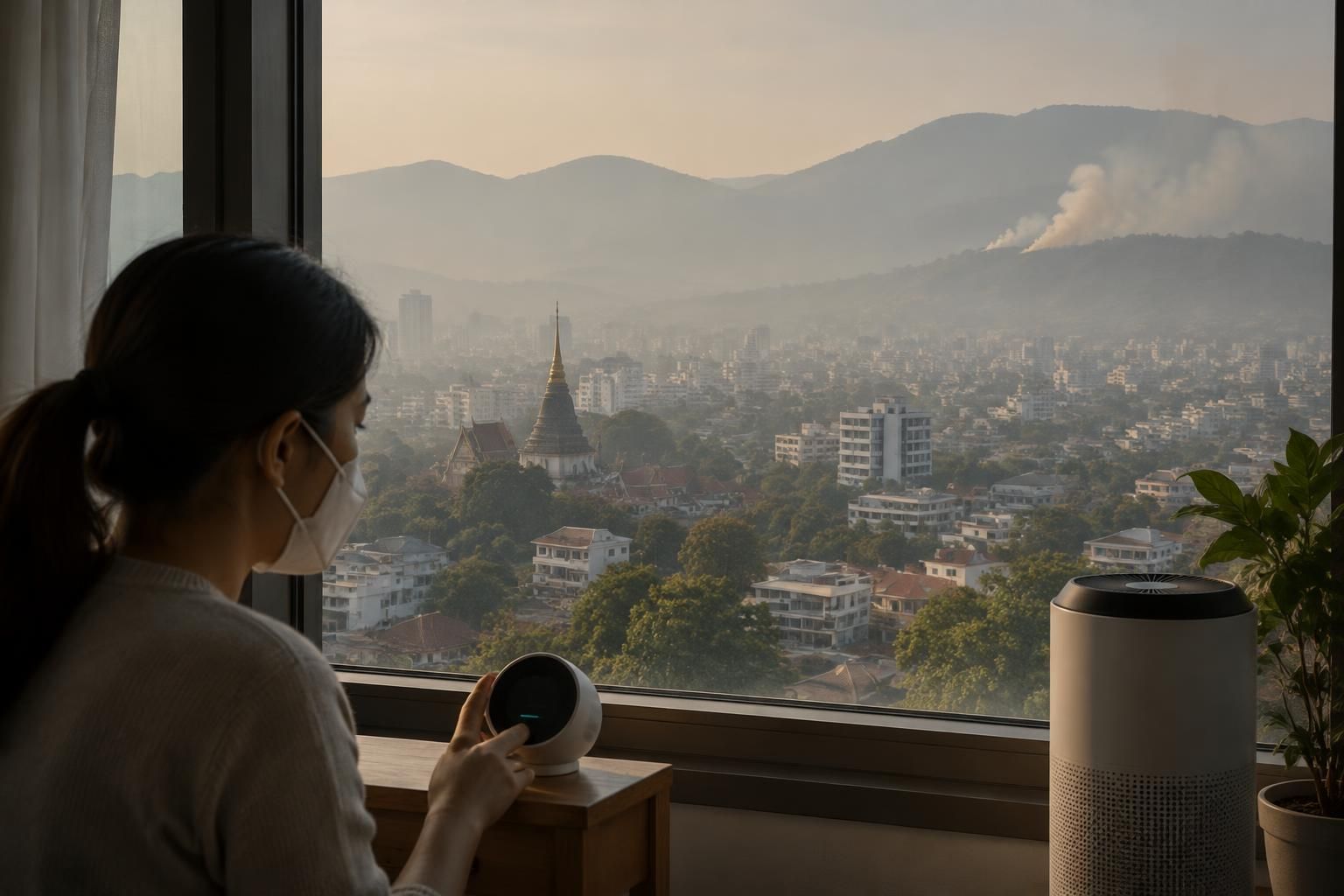
In Chiang Mai, the dry-season landscape can change dramatically: mountains fade behind a grey veil, outdoor plans become harder to enjoy, and residents and visitors must pay closer attention to the air they breathe. The Chiang Mai burning season usually affects northern Thailand between January and April, with especially difficult conditions often occurring in March.
The smoke comes from several sources, including agricultural burning and forest fires, and weather can trap pollution around the city. For travelers, the practical questions are immediate: whether to change a booking, how to find a room with cleaner air, and when a mountain excursion is worth postponing. A little preparation can make those decisions less stressful, although it cannot eliminate exposure.
At a glance
- Smoke conditions vary each year, but March and early April often carry the greatest risk.
- Check both the local air quality index and PM2.5 readings before making outdoor plans.
- A well-fitting N95 mask and a properly sized air purifier can reduce particle exposure.
- Children, older adults, pregnant people, and anyone with heart or lung conditions should take particular care.
- Flexible bookings and a backup destination can make a smoky-season trip easier to manage.
When Is Chiang Mai Burning Season and What Does It Feel Like?
The burning season generally develops during northern Thailand’s dry months, from approximately January through April. It does not arrive on a fixed date: rainfall, wind, fire activity, and local weather patterns all influence when smoke becomes noticeable and how long it lasts.
March is often the month travelers hear about most, and conditions can remain difficult into April. Some years bring earlier episodes or a later improvement, so a calendar is useful for planning but cannot replace current readings.
Why the Haze Changes from Day to Day
A clear morning can give way to a smoky afternoon, or the reverse. Winds can transport smoke from fires elsewhere in northern Thailand and neighboring parts of the region, while shifting weather can disperse or concentrate particles around Chiang Mai.
The city’s setting adds to the problem. Surrounded by mountains, the Chiang Mai basin can hold polluted air when winds are weak and temperature inversions limit vertical mixing. In simple terms, a layer of warmer air can act like a lid over cooler air near the ground.
There is no reliably clean hour that works every day. Someone hoping to walk around the Old City at sunrise should check the latest measurements rather than assume that early morning is automatically safer.
What Visitors Notice During a Smoky Spell
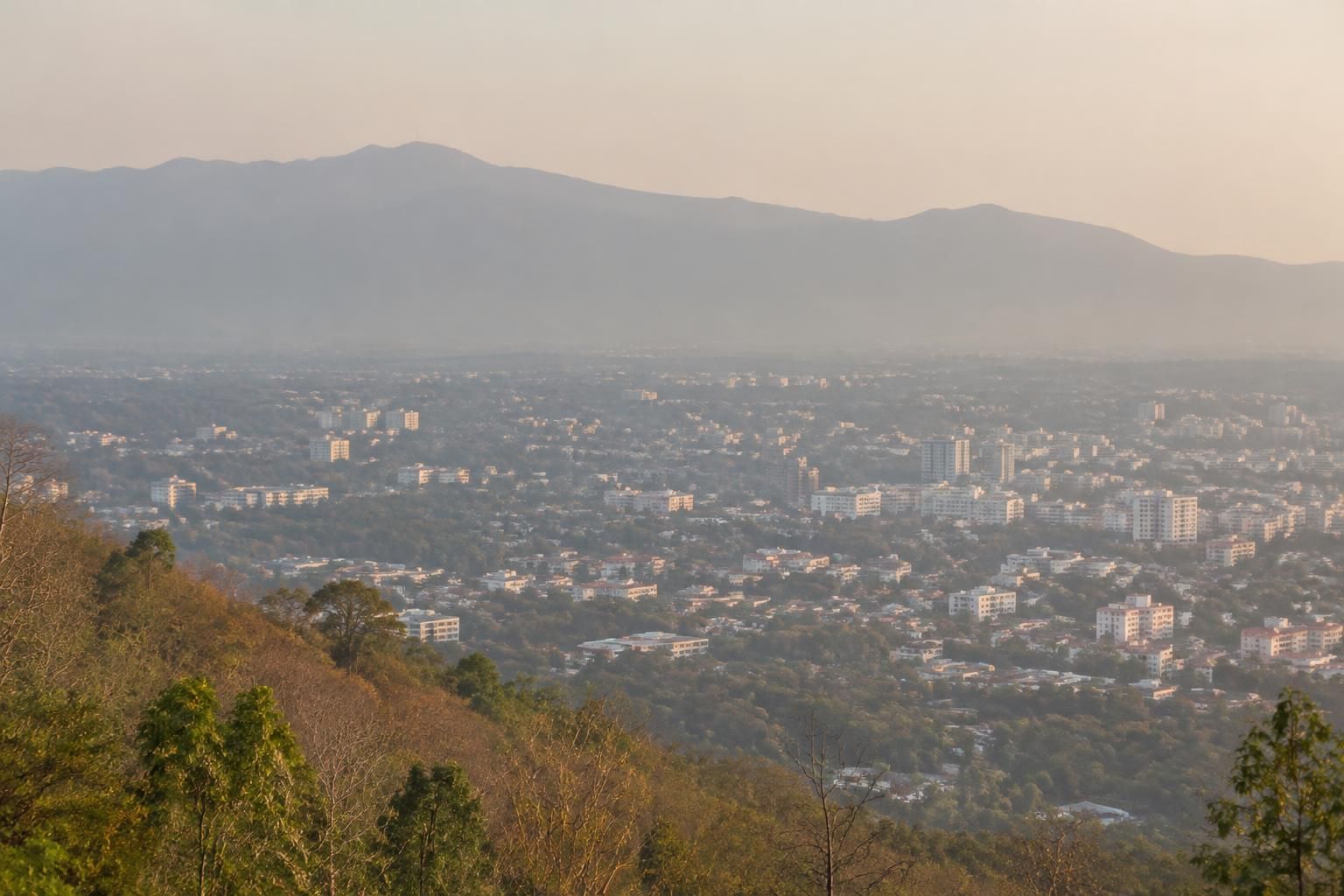
Visibility is often the first sign. Doi Suthep, normally a prominent backdrop to the city, may appear faint or disappear altogether; distant hills and temple photographs can look washed out.
There can also be a smell of smoke, irritated eyes, or a scratchy throat. Yet smell and appearance are imperfect guides: fine particles can be present even when the sky looks less dramatic, and a strong smell does not tell a traveler the exact concentration.
Imagine a visitor called Maya arriving for a week of temple visits and mountain walks. On a clear-looking first morning, she checks a nearby monitoring station before booking a hike; a poor reading prompts her to move the excursion and choose an indoor activity instead.
That small change also protects the time and money already invested in the trip. Tour operators may have different cancellation policies, so asking about weather and smoke alternatives before paying for a full-day excursion is worthwhile.
April adds another consideration: heat. Daytime temperatures can become uncomfortable, especially when a tightly fitting respirator is needed outdoors. Carrying water and scheduling breaks helps with heat, but neither removes pollution from the air.
Rain often improves conditions by dampening fires and clearing particles, but the first shower is not a guarantee that the season has ended. The useful insight for planning is to treat the season as a changing exposure risk rather than a single event with a predictable finish.
What Causes Chiang Mai Air Pollution During Burning Season?
Smoke in northern Thailand has several overlapping causes. Agricultural burning, forest fires, traffic, and other combustion sources all contribute to air pollution, while dry weather and geography affect how much accumulates near people.
It is tempting to identify a single group as responsible, but that would miss the economic and environmental pressures behind the problem. Understanding those pressures makes the haze easier to interpret and avoids placing the entire burden on communities with few affordable alternatives.
Agricultural Burning and Rural Livelihoods
After harvest, farmers may burn crop residues or vegetation to prepare land for another planting cycle. Fire is relatively quick and inexpensive, and ash can return some nutrients to the soil, although repeated burning can also damage soil and surrounding ecosystems.
Alternatives are not equally accessible everywhere. On steep land, bringing in machinery can be difficult; for smallholders, the cost of equipment, labor, or transporting crop waste can make a no-burn approach hard to sustain without practical support.
Commercial crop production matters too. Demand for crops such as maize can generate substantial residue across a wide area, meaning that supply chains, buyers, land management policies, and farmers all have a role in finding workable alternatives.
A policy that simply tells a small farm to stop burning may sound straightforward from a hotel room. In practice, solutions also need affordable equipment, collection systems, incentives, and markets for crop residues that would otherwise be costly to handle.
Forest Fires, Foraging, and Smoke from Across Borders
Forest fires are another important source, though their causes differ. Some are accidental or spread from agricultural land; others are set deliberately for land management or other purposes, and dry leaves can allow flames to travel quickly.
In some communities, fire is associated with forest access and the collection of valuable seasonal products, including hed thob mushrooms. The relationship between fire and mushroom harvests is complex, however, and it is misleading to say the mushrooms grow only after a forest has burned.
Smoke also crosses provincial and national borders. A traveler looking at a map of nearby fires may not see every source affecting the city, because particles can travel long distances before settling into the basin.
Vehicles and urban activities add emissions throughout the year. They matter to local exposure, but during severe dry-season episodes, fire-related smoke can substantially worsen an already existing pollution burden.
Rules restricting fires can help, particularly when enforcement is paired with support for communities managing land. Prevention, early detection, and cooperation across borders also matter because a fire stopped before it spreads produces less smoke to manage later.
For Maya, this broader picture changes the conversation with a local guide: asking how communities cope is more useful than assuming every smoky field has the same story. The next practical question is how to turn that complex picture into a daily decision about exposure.
How to Read Chiang Mai Air Quality Index and PM2.5 Levels
The air quality index, or AQI, translates measurements of pollutants into a scale intended to make health guidance easier to understand. PM2.5 is a different measurement: it describes the concentration of very small airborne particles, usually in micrograms per cubic meter, written as µg/m³.
The two numbers are related, but they are not interchangeable. An AQI value of 150 does not mean a PM2.5 concentration of 150 µg/m³, and different countries can use different formulas and categories for their indexes.
Understanding PM2.5 and Health Guidance
PM2.5 particles are small enough to penetrate deep into the lungs, and some can enter the bloodstream. Exposure can irritate the eyes and airways and aggravate asthma, while high or prolonged exposure is associated with cardiovascular and respiratory health risks.
The World Health Organization’s guideline for average PM2.5 exposure over 24 hours is 15 µg/m³. It is a health-based guideline, not a promise that a lower reading removes all risk, and it should not be compared directly with a single hourly measurement.
A monitoring app may display an hourly concentration, a rolling average, or an AQI calculated from a particular standard. Checking the label, the time period, and the station location helps prevent a confusing comparison between two different screens.
| U.S. AQI | Category | Practical response |
|---|---|---|
| 0–50 | Good | Outdoor activities are generally acceptable for most people. |
| 51–100 | Moderate | Unusually sensitive people may want to adjust prolonged exertion. |
| 101–150 | Unhealthy for sensitive groups | People at higher risk should reduce prolonged or strenuous outdoor activity. |
| 151–200 | Unhealthy | Everyone should reduce exposure; sensitive groups should take extra care. |
| 201–300 | Very unhealthy | Avoid or substantially limit outdoor exertion and seek cleaner indoor air. |
| 301 and above | Hazardous | Follow local health advice and minimize outdoor exposure. |
The table uses the U.S. AQI; Thai AQI categories and breakpoints differ. Always check which scale an app uses before comparing colors or thresholds.
Choosing a Useful Monitoring Station
Thailand’s Pollution Control Department provides official air-quality information, including through its Air4Thai service. Other monitoring platforms can provide useful local context, but sensor type, calibration, update frequency, and the way the index is calculated may vary.
For a day around the Old City, Maya can start with a station near her accommodation and check again before a longer outing. A monitor near a busy road may not perfectly represent a room several streets away, while a citywide average can hide local differences.
What if two services disagree? Rather than choosing the more reassuring number, compare their locations, timestamps, pollutants, and index systems; when the picture remains poor, a cautious plan is sensible.
Air-quality data guides decisions rather than replacing medical advice. The number becomes most useful when it leads to a concrete action: shorten an outdoor visit, use protection, or move plans to a cleaner indoor space.

How to Protect Respiratory Health During Chiang Mai Smoke
There is no single product that makes smoky air harmless. The strongest approach combines less time in polluted air, a well-fitting respirator when outside, and a cleaner indoor room for rest.
For people with asthma, chronic obstructive pulmonary disease, heart disease, or other relevant conditions, a conversation with a healthcare professional before travel can help shape an individual plan. Children, older adults, and pregnant people may also need a more cautious approach.
Choosing and Wearing an N95 Mask
An N95 mask or another certified particulate respirator can filter fine particles effectively when it fits closely against the face. Gaps around the nose or cheeks reduce protection, so the seal matters as much as the label on the package.
Follow the manufacturer’s fitting instructions and perform a user seal check each time. Facial hair where the mask meets the skin can prevent a good seal, and a mask that becomes damaged, dirty, or difficult to breathe through should be replaced.
Surgical and cloth masks generally provide less reliable protection against fine particles because filtration and fit vary. Respirators also do not filter all gases or eliminate every risk associated with smoke.
For children, look for a reputable, appropriately sized particulate respirator and follow pediatric guidance; adult N95s may not fit a child properly. Masks are not suitable for very young children, including children under two, and anyone who cannot remove one independently needs particular care.
Creating a Cleaner Room Indoors
A portable air purifier with a HEPA filter, or another effective particle filter, can lower indoor particle levels when it is appropriately sized for the room. Check the clean air delivery rate, keep the unit running as recommended, and replace filters according to the manufacturer’s instructions.
Before booking, Maya asks the guesthouse whether the purifier is in her actual room, whether its filter is maintained, and whether doors and windows can close properly. A purifier in the reception area may be helpful there, but it does not guarantee clean air in a bedroom upstairs.
Air conditioning can make a closed room more comfortable, but it does not automatically provide effective particle filtration. Avoid devices that deliberately generate ozone, which can irritate the lungs, and limit indoor particle sources such as smoking, candles, and frying.
During a short car journey, closing windows and using the ventilation system’s recirculation setting can reduce the amount of smoky outside air entering. An enclosed car is generally a more protective choice than an open tuk-tuk or motorbike, though it cannot remove exposure entirely.
Drinking water and resting may ease discomfort, but they do not clear PM2.5 from the lungs or substitute for reducing exposure. If symptoms such as wheezing, chest pain, marked breathlessness, or worsening illness develop, seek prompt medical care; severe breathing difficulty or chest pain needs urgent attention.
Protection works best when it is arranged before the smoke arrives. Once a safer room and transportation plan are in place, the remaining challenge is deciding how to spend the day without turning a holiday into an endurance test.
How to Plan a Chiang Mai Trip Around Burning Season
For travelers with flexible dates, avoiding the peak risk period is often the simplest way to reduce exposure. November through January can be appealing for cooler, generally clearer conditions, although no month guarantees perfect air and early smoke episodes can occur.
If March or April is the only available window, the decision deserves an honest look at health needs, budget, and the activities that matter most. A trip centered on trekking and mountain views carries a different risk of disappointment from one built around cooking classes and indoor creative work.
Booking Accommodation and Keeping Options Open
Look for accommodation with a room-sized purifier, well-sealed windows, and clear answers about filter maintenance. A comfortable indoor place to rest is especially valuable when several smoky days occur together.
Flexible cancellation or a shorter initial booking can give visitors room to respond to changing conditions. Before paying, ask whether a date change is possible, what notice is required, and whether any refund comes from the hotel, booking platform, or tour operator.
Maya might reserve three nights rather than committing to two weeks, then decide whether to extend after checking current conditions and how she feels. That approach does not predict the air, but it limits the pressure to remain somewhere that is not working for her.
For broader trip ideas, explore Thailand travel inspiration and consider more ideas for planning a Thailand stay alongside current transport and air-quality information.
Changing the Itinerary Without Losing the Experience
On poor-air days, a cooking class, museum, café, or coworking space may be more manageable than an exposed hike. Air conditioning alone does not guarantee clean air, however, so ask about filtration and choose spaces that are comfortable rather than assuming every mall is a clean-air refuge.
Visitors can also save outdoor activities for a better day and avoid strenuous exercise when readings are high. A shorter temple visit reached by enclosed car may be more realistic than a long walk between sites, particularly in the afternoon heat.
Some travelers choose to move south within Thailand or consider coastal destinations such as Da Nang or Nha Trang in Vietnam. Those places are not automatically smoke-free: check their current air quality, weather, transport requirements, and cancellation terms before changing course.
Residents may not have the option of leaving, and tourism workers continue to live with the effects long after a visitor departs. Choosing local businesses that offer suitable indoor activities can support livelihoods while allowing a traveler to adjust responsibly.
Before an excursion, confirm the latest reading, the forecast, and the provider’s change policy. If Maya wakes to heavy smoke on the day of her planned mountain trip, postponing it is not a failed holiday plan; it is a practical decision that leaves room for a better day.