
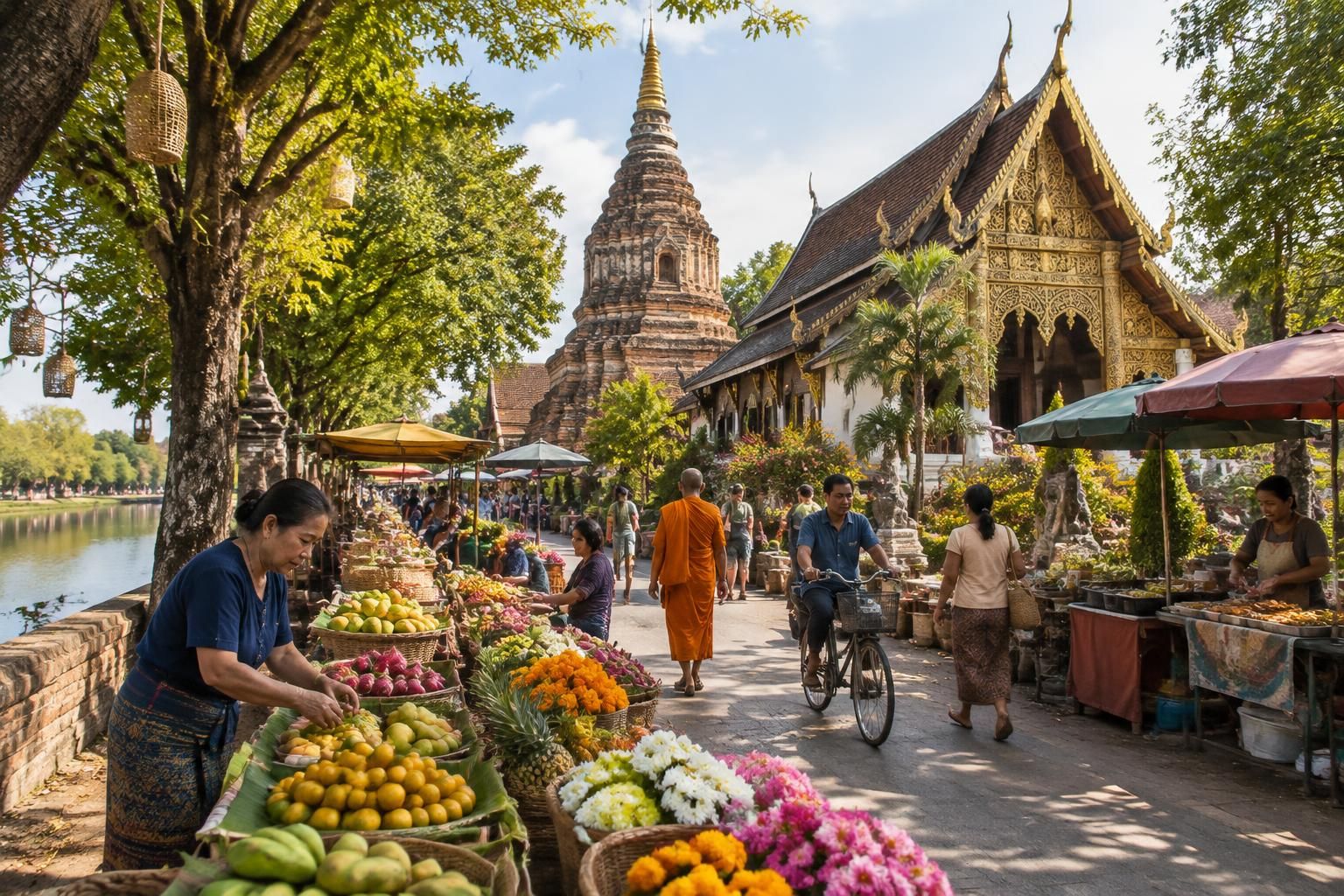
Behind Chiang Mai’s old walls, temple bells mingle with the sounds of scooters, market bargaining and breakfast being prepared on the pavement. The Old City is compact enough to explore on foot, yet its lanes reward a slower pace: a morning can move from a centuries-old chedi to a fruit stall, then into a shaded courtyard where residents pause between errands.
This travel guide follows the district’s eastern gate through its central historic sites and westward to Wat Phra Singh, with practical detours for food, museums and quieter residential streets. It also makes room for the realities of a day in northern Thailand: midday heat, changing temple hours, uneven pavements and the welcome relief of a long lunch. For a first-time visitor such as Maya, an imaginary traveler spending a few days in Chiang Mai, the most memorable moments may be the small ones between the major landmarks.
At a glance
- Best walking times: Early morning or late afternoon, with an indoor break during the hottest hours.
- Core route: Tha Phae Gate, Sompet Market, Wat Chiang Man, Three Kings Monument, Wat Chedi Luang, Wat Phan Tao and Wat Phra Singh.
- Allow: Two to three hours for a shorter walk, or most of a day with meals and museums.
- Bring: Water, sun protection, modest clothing and small amounts of cash.
- Market days: Sunday Walking Street runs along Ratchadamnoen Road; Wualai’s Saturday market is south of Chiang Mai Gate.
- Before setting out: Check current opening hours, entry fees and air quality, especially during the smoky season.
Chiang Mai Old City Walking Route: Gates, Lanes and Historic Sites
The Old City occupies a roughly square area surrounded by a moat and remnants of defensive walls. Founded under King Mangrai in the late thirteenth century, Chiang Mai became a center of the Lanna kingdom; today, its historic core remains a working neighborhood rather than a preserved monument.
Guesthouses, schools, small shops and places of worship share the same streets. That mixture makes walking rewarding, but it also means visitors are moving through spaces that other people use every day. Keeping entrances clear and stepping aside for scooters on narrow lanes makes a noticeable difference.
Start at Tha Phae Gate and Sompet Market
Begin at Tha Phae Gate, on the eastern side of the moat. Facing west through the gate gives a useful orientation: Ratchadamnoen Road leads into the heart of the old quarter, while Moon Muang Road runs north along its eastern edge.
Maya’s first stop is Sompet Market, reached by walking north and turning into the lanes near Moon Muang Road Soi 6. In the morning, vendors sell fruit, prepared dishes and ingredients for nearby kitchens. A portion of rice soup or a bag of cut fruit makes an easy breakfast, and small notes are useful for purchases.
Rather than treating the market as a photo opportunity alone, watch how customers order and allow room around the counters. Asking before taking a close portrait is a simple way to keep the exchange comfortable for everyone.
Walk from Wat Chiang Man to the western lanes
From the market, head west through the smaller streets toward Wat Chiang Man, traditionally regarded as Chiang Mai’s oldest temple. Its elephant-supported chedi offers an early encounter with Lanna religious architecture, while the quieter surroundings make it a gentle first stop.
Continue toward the Three Kings Monument, where statues of Mangrai, Ramkhamhaeng and Ngam Muang commemorate the rulers associated with the city’s founding. The nearby museums provide context for the buildings and customs encountered outside, and their indoor galleries are especially welcome when the sun is strong.
From the monument, walk south to Wat Chedi Luang and neighboring Wat Phan Tao. Then turn west toward Wat Phra Singh, using Ratchadamnoen Road or one of its parallel lanes. The latter offer glimpses of guesthouses, gardens and small businesses that are easy to miss on a direct landmark-to-landmark walk.
Choose a comfortable pace around the Old City
A shorter route ending near Wat Phan Tao can take two to three hours, while adding Wat Phra Singh, a museum and leisurely meals turns the outing into a half-day or longer. Distances vary with detours, but the main walk is generally around four to seven kilometers.
Early morning, roughly 6:30 to 9:30, is often more comfortable than midday. If Maya starts later, she can visit a museum or café around lunch and return to the streets after 16:00, checking temple closing times before planning a late visit.
The terrain is mostly flat, but that does not guarantee step-free access: pavements can be interrupted, crossings busy, and temple courtyards uneven. Travelers using wheelchairs or strollers should allow extra time and check individual entrances. A flexible route leaves room for these practical details—and for the living neighborhood that connects the major temples.
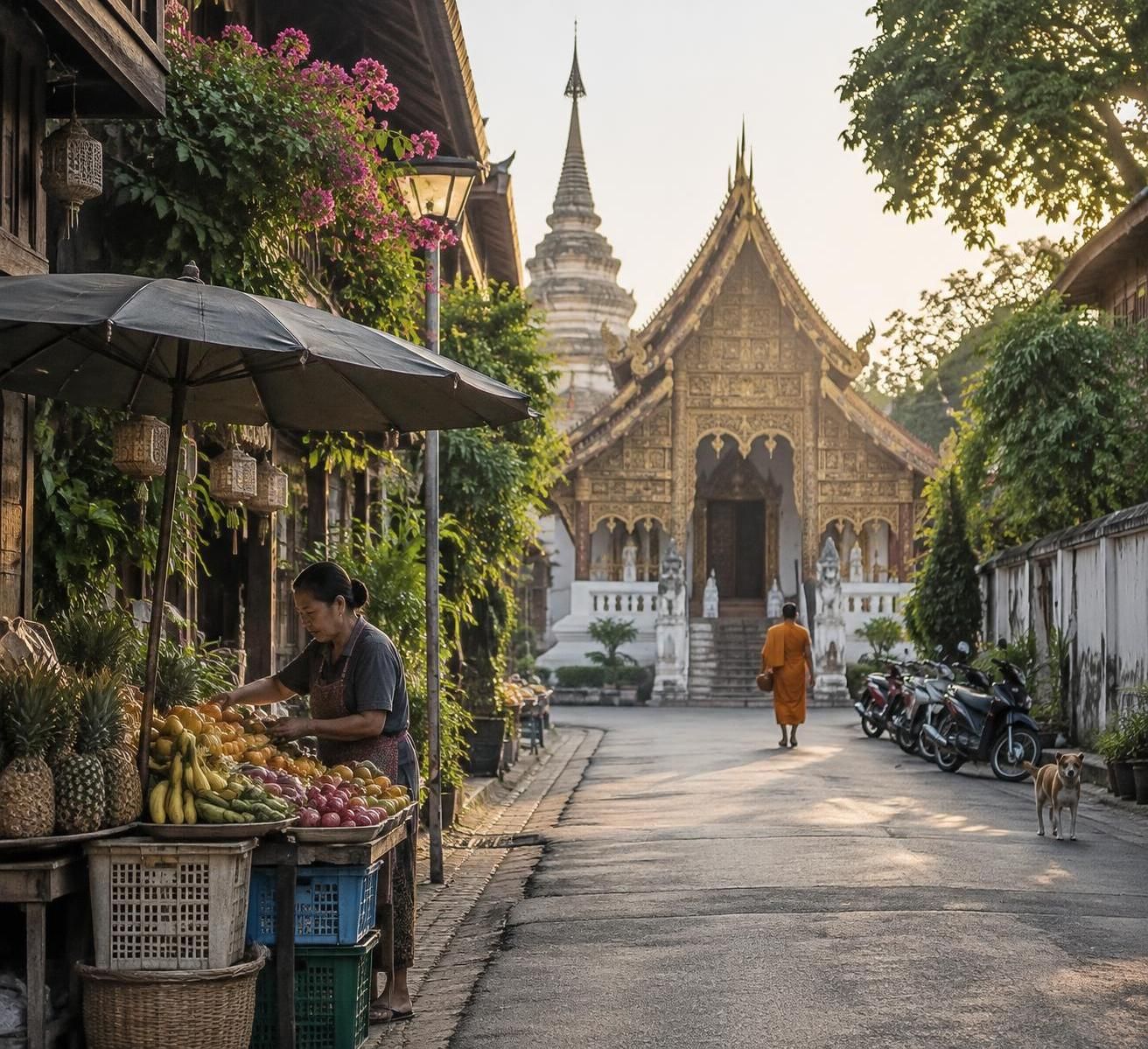
Chiang Mai Temples: Lanna Architecture and Respectful Visits
The temples inside the moat differ in scale and atmosphere. Some are grand compounds with elaborate assembly halls; others feel intimate, with timber details and courtyards that invite a quiet pause. Visiting a few attentively offers a better understanding of Thai culture than rushing through a long checklist.
Wat Chiang Man and Wat Chedi Luang
Wat Chiang Man dates to the early years of Chiang Mai’s history. Its most recognizable feature is the Elephant Chedi, whose stone elephants appear to support the structure above them. Walk around the grounds slowly and notice the contrast between the old masonry, gilded details and active spaces for worship.
The temple also houses revered Buddha images. Their display and access can vary, so follow signs and avoid assuming that every interior is open for photography. A donation may be welcomed, but it is not an obligation: give what feels comfortable rather than treating a suggested amount as a compulsory fee.
Farther south, Wat Chedi Luang makes a different impression. Its enormous brick chedi was begun in the late fourteenth century and damaged by an earthquake in the sixteenth. Even in its altered state, it conveys the importance of the city that built it.
The complex once housed the Emerald Buddha, now kept at Wat Phra Kaew in Bangkok. That history connects Chiang Mai to wider movements of religious and political authority across the region. Foreign visitors are generally charged an entry fee, so check the current price at the entrance before paying.
Wat Phan Tao and Wat Phra Singh
Next door to Chedi Luang, Wat Phan Tao offers a more intimate contrast. Its dark teak assembly hall is especially striking when light falls across the carved entrance and wooden pillars. Moving between the two sites shows how different materials can shape the mood of a sacred space.
At the western end of Ratchadamnoen Road, Wat Phra Singh is known for its Lanna-style buildings and revered Buddha image. Look for layered roofs, carved gables and murals in Wihan Lai Kham; the details repay a slower look than a quick photograph from the doorway.
Access rules and charges can differ between temple grounds and individual buildings. Rather than relying on an old price list, ask at the entrance or check with a guesthouse on the day. For further ideas while planning a visit, explore more Chiang Mai travel inspiration.
Temple etiquette that makes a visit easier
Cover shoulders and knees, and remove shoes before entering buildings where signs or local practice require it. Sandals are practical because they slip off easily, but secure footwear is more comfortable on uneven stone. A scarf can cover shoulders; a longer skirt or trousers is more reliable for covering knees.
Speak softly around worshippers and avoid pointing feet toward Buddha images when sitting. Ask permission before photographing monks or individuals at prayer, and follow posted restrictions even when other visitors are taking pictures.
Some buildings or areas may restrict entry, including on the basis of local religious rules. If a doorway is closed or a ceremony is underway, respect the boundary rather than assuming it is an inconvenience to be negotiated. A temple visit is most meaningful when the building is understood as an active place of devotion, not simply a historic backdrop.
Chiang Mai Markets and Street Food: Where Local Life Unfolds
Markets give a different view of the Old City from its monumental architecture. They are places to buy breakfast, choose ingredients and meet friends, as well as places where visitors can sample northern Thai cooking. Going at the right time matters: a morning produce market and an evening night market serve different purposes and feel entirely different.
Breakfast at Sompet and Chiang Mai Gate
Sompet Market is convenient for a walk beginning near Tha Phae Gate. Early in the day, Maya might choose rice soup, fresh pineapple or a prepared curry, then take a seat where seating is provided. Watching what regular customers order is useful when menus are limited, though it is still wise to ask about ingredients if allergies are a concern.
At the southern edge of the Old City, Chiang Mai Gate Market is another good breakfast stop. Its fresh produce and ready-made dishes make it a practical alternative for travelers staying near the south gate. Arriving hungry is useful; arriving with small cash makes quick transactions easier.
Market hours and individual stalls change. If a particular vendor matters, ask locally rather than building the entire day around an online listing. When a favorite breakfast stall has sold out, a nearby fruit seller or noodle shop can become an equally satisfying discovery.
Sunday Walking Street and Wualai Saturday Market
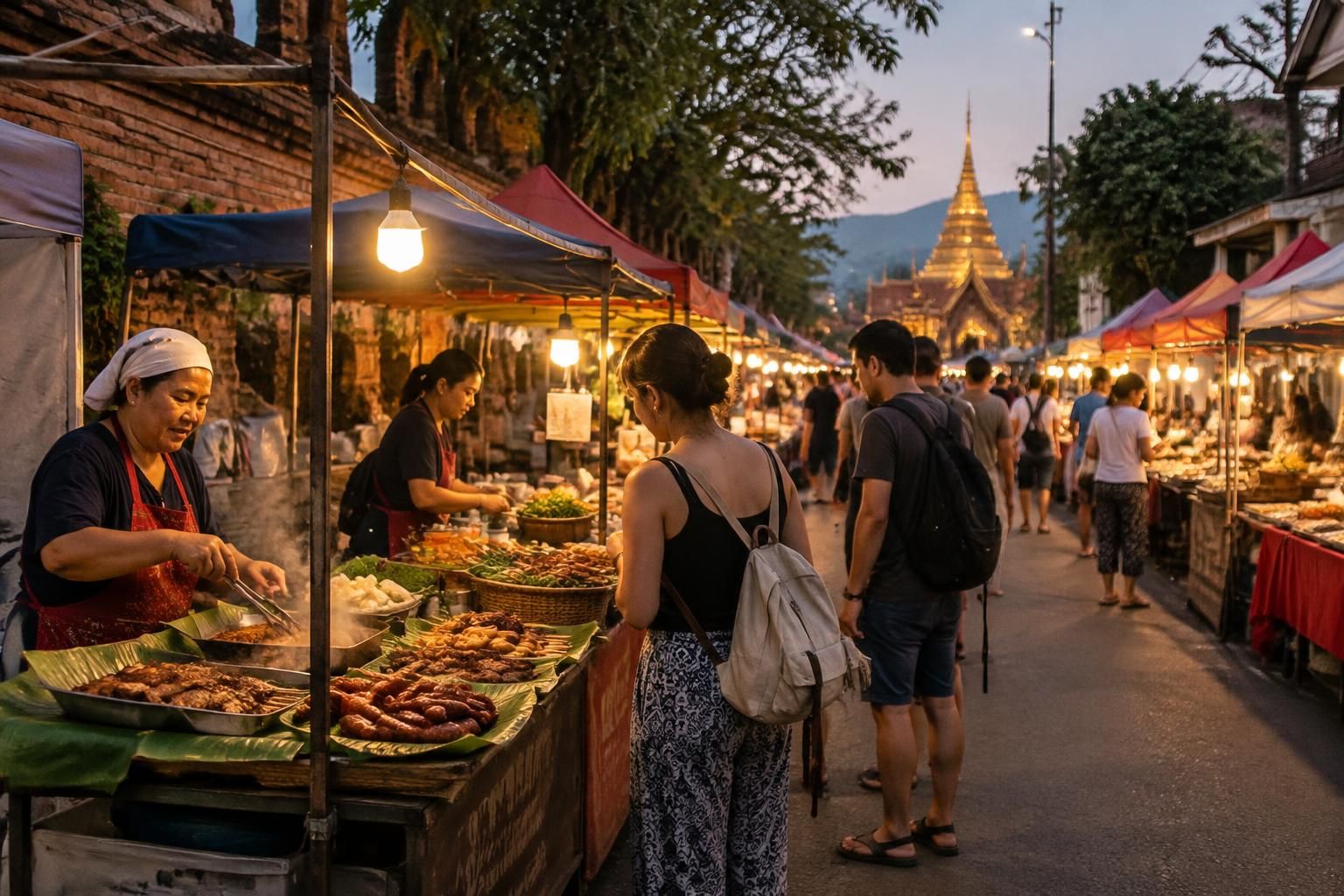
On Sundays, Ratchadamnoen Road becomes the setting for Sunday Walking Street, typically gathering pace from late afternoon into the evening. Food stalls, crafts and performers draw substantial crowds, so an early arrival is helpful for anyone who prefers space to browse.
On Saturdays, Wualai Road south of Chiang Mai Gate hosts a separate walking market. It is associated with the area’s silverworking heritage, alongside the food and souvenir stalls. Neither event replaces the daily rhythm of smaller neighborhood vendors; each offers a lively evening experience of its own.
For a less crowded meal, the area around Chang Puak Gate on the northern side of the moat is known for evening food stalls. Braised pork leg with rice is a popular choice there, although individual vendors’ schedules can change.
Ordering northern Thai food with confidence
Look for khao soi, a northern Thai curry noodle dish often served with pickled greens, shallots and lime. Sai ua, a fragrant northern sausage, and nam prik, a chili dip eaten with vegetables or other accompaniments, offer different ways to explore regional flavors.
Spice levels vary, and vegetarian or allergy requirements deserve a clear conversation rather than an assumption. Showing a carefully translated dietary note can help; for serious allergies, ask specifically about shared equipment and ingredients such as fish sauce, shrimp paste and peanuts.
Street food is often inexpensive, with a simple meal commonly budgeted around 50–120 baht, though location and portion size affect the bill. Choose busy stalls where food is freshly prepared, and carry drinking water for the walk between stops.
Shopping with curiosity also means respecting the people doing the work. Ask before photographing a stallholder, avoid blocking customers while deciding, and consider buying directly from the maker when a craft catches your eye. The best market encounters are exchanges, not performances arranged for visitors.
Where to Stay in Chiang Mai Old City and How to Get Around
Choosing a base is less about finding the single best neighborhood than matching the location to the trip. Someone planning early temple walks may value a room inside the moat, while a longer-stay visitor who works from cafés may prefer a different district. Noise, stairs, transport and check-in times can matter as much as the view in the booking photos.
East, central or west Old City?
Near Tha Phae Gate, accommodation puts first-time visitors close to transport, cafés and the eastern approach to the Night Bazaar. The area is convenient and lively, but a room beside a busy road or bar may not suit a light sleeper. Ask whether a quieter room faces an interior courtyard.
Central addresses place several major temples and museums within an easy walk. This is useful for Maya, who wants to return to her room for a midday rest rather than carry everything all day. On Sunday, however, check how the walking street affects vehicle access if arriving with luggage.
Near Wat Phra Singh, smaller lanes have a more residential feel, with guesthouses, cafés and massage studios. Quiet is never guaranteed, so check recent reviews for construction, traffic or music rather than relying on the neighborhood label alone.
| Area | Good fit | Practical consideration |
|---|---|---|
| East Old City | First visits and easy access to Tha Phae Gate | Busy streets can be noisy |
| Central Old City | Walking to temples and museums | Sunday market closures can affect pickups |
| West Old City | Quieter lanes and smaller guesthouses | Check the exact street and room location |
| Nimman | Cafés, longer stays and a modern setting | Transport is useful for Old City visits |
| Riverside | Relaxed hotels and dining near the Ping River | Allow extra travel time to the temples |
Transport, accessibility and everyday costs
The central district is walkable, but walking is not always the easiest choice in heat, rain or poor air quality. Songthaews, the red shared trucks, can be flagged down; confirm the destination and fare before boarding. Tuk-tuk prices should also be agreed in advance.
For a longer ride, a service such as Grab can show a price before booking, subject to availability. Allow extra time around markets, where road closures and crowds can move pickup points away from the address shown on a map.
Travelers with limited mobility should contact accommodation directly about lifts, entrance steps and bathroom layouts. Flat streets do not necessarily mean accessible pavements, and temple thresholds can be difficult for wheels. A short vehicle transfer between selected stops may make a day substantially more comfortable.
Budget for more than room rates: museum tickets, temple fees, meals, drinks and occasional transport all add up. A café coffee and snack might cost around 100–200 baht, while a simple sit-down lunch can cost more. These are planning estimates rather than fixed prices.
For broader trip-planning ideas beyond the moat, browse more Thailand travel ideas. Wherever the room is booked, a location that supports rest and easy departures makes the cultural sights more enjoyable.
Planning a Comfortable Chiang Mai Old City Day
A good day in the Old City balances curiosity with the conditions on the ground. Heat, seasonal smoke, sudden rain and crowded market streets can all change the most sensible route. The solution is not to abandon plans, but to leave enough space to adjust them.
A practical day from breakfast to evening
Maya starts at Tha Phae Gate around 7:30, walks north for breakfast at Sompet Market and reaches Wat Chiang Man while the morning is still relatively cool. She then heads to the Three Kings Monument, allowing time to look around the square rather than treating it as a quick photo stop.
As temperatures rise, she chooses one museum. The Chiang Mai City Arts and Cultural Center provides historical context, while the Lanna Folklife Museum focuses on aspects of regional daily life and traditions. Checking the day’s opening hours first prevents an unnecessary trip to a closed door.
After lunch and a rest, she visits Wat Chedi Luang and Wat Phan Tao, then continues toward Wat Phra Singh if its buildings are still open. On Sunday, she can remain near Ratchadamnoen Road for the walking street; on another day, Chiang Mai Gate or Chang Puak Gate offers an evening food option.
Weather, air quality and personal safety
March through May can be particularly hot, making a midday break more than a luxury. Carry water, use sun protection and stop in the shade before feeling exhausted. In the rainy season, a light rain layer and footwear with reliable grip are useful on wet pavements.
Air quality can deteriorate during the smoky season, often between approximately February and April. Check a current local air-quality reading before a long walk. When pollution is high, shorten outdoor exposure, consider indoor activities and follow health guidance, especially for children and people with respiratory or heart conditions.
The Old City is generally comfortable to explore, including in the evening, but normal awareness still matters. Keep valuables secure, choose well-lit routes at night and give yourself time at busy road crossings. If a stranger says a major temple is closed and offers an unsolicited diversion, verify the information with temple staff before accepting a ride.
Dogs sometimes rest near lanes or temple grounds. Give them space, avoid approaching puppies and move away calmly if an animal appears agitated. If bitten or scratched, wash the wound promptly and seek medical care for advice, including rabies assessment.
Extensions beyond the moat
If another day is available, Wat Lok Molee lies just north of Chang Puak Gate and adds a quieter temple stop to a northern extension. Wat Suan Dok is west of the Old City; check the distance from your starting point and use transport if heat or traffic makes the walk unappealing.
Doi Suthep is a separate mountain excursion rather than a quick Old City detour. Travelers considering an elephant experience outside town should examine welfare practices carefully, favoring observation without riding or forced performances and asking how the animals are managed.
For families, shorter walks with fruit stops and reliable toilets are often more enjoyable than a packed itinerary. For travelers with more time, returning to a favorite lane or market on another morning reveals how local life changes across the day—and makes space for a Chiang Mai experience shaped by attention rather than distance covered.