
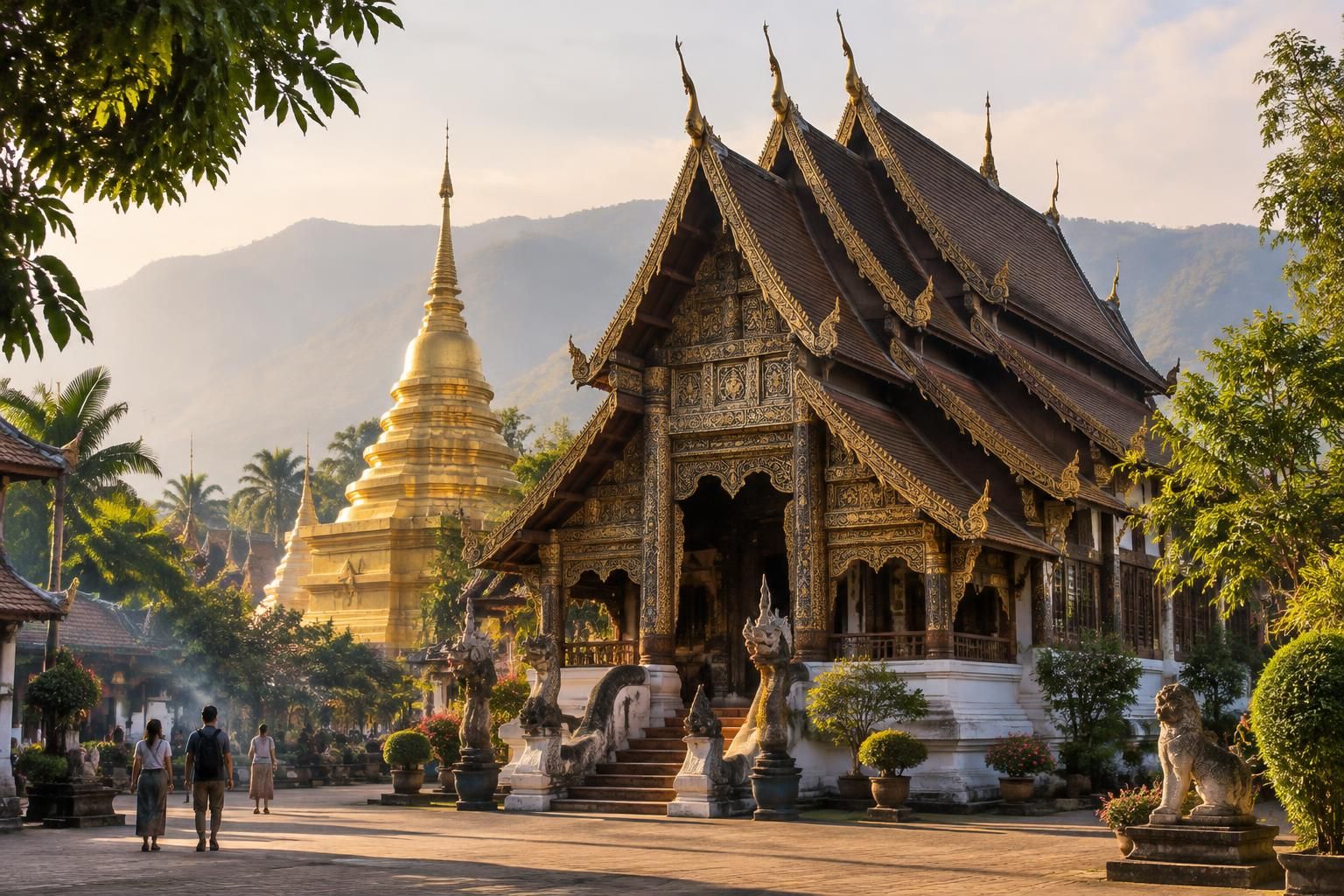
Chiang Mai’s temples are places of worship, community gathering spots and living records of the old Lanna kingdom. For a traveler with only a few days, the challenge is not finding a beautiful wat but choosing a handful that offer genuinely different experiences: a mountain pilgrimage, a monumental brick ruin, a richly painted hall or a quiet walk through forest.
Wat Phra That Doi Suthep is the memorable mountain choice, while Wat Chedi Luang and Wat Phra Singh anchor an easy Old City walk. Add Wat Chiang Man for early city history or Wat Umong for its meditation tunnels, and allow enough time to notice how each site serves local worshippers as well as visitors. The following route follows a fictional traveler, May, as she plans two unhurried days, with practical details for anyone who would rather explore thoughtfully than rush through a checklist.
At a glance
- Best mountain visit: Wat Phra That Doi Suthep for its golden chedi and valley views.
- Best Old City pairing: Wat Chedi Luang for history and Wat Phra Singh for art and architecture.
- Quieter alternatives: Wat Chiang Man, Wat Umong and forested Wat Pha Lat.
- What to wear: Clothing that covers shoulders and knees, with footwear that is easy to remove.
- Time to allow: A half-day for the Old City and another for Doi Suthep; a second full day leaves room for a forest temple.
- Budget: Carry small amounts of cash for admission, transport and optional donations; prices can change.
Wat Phra That Doi Suthep: Chiang Mai’s Mountain Pilgrimage
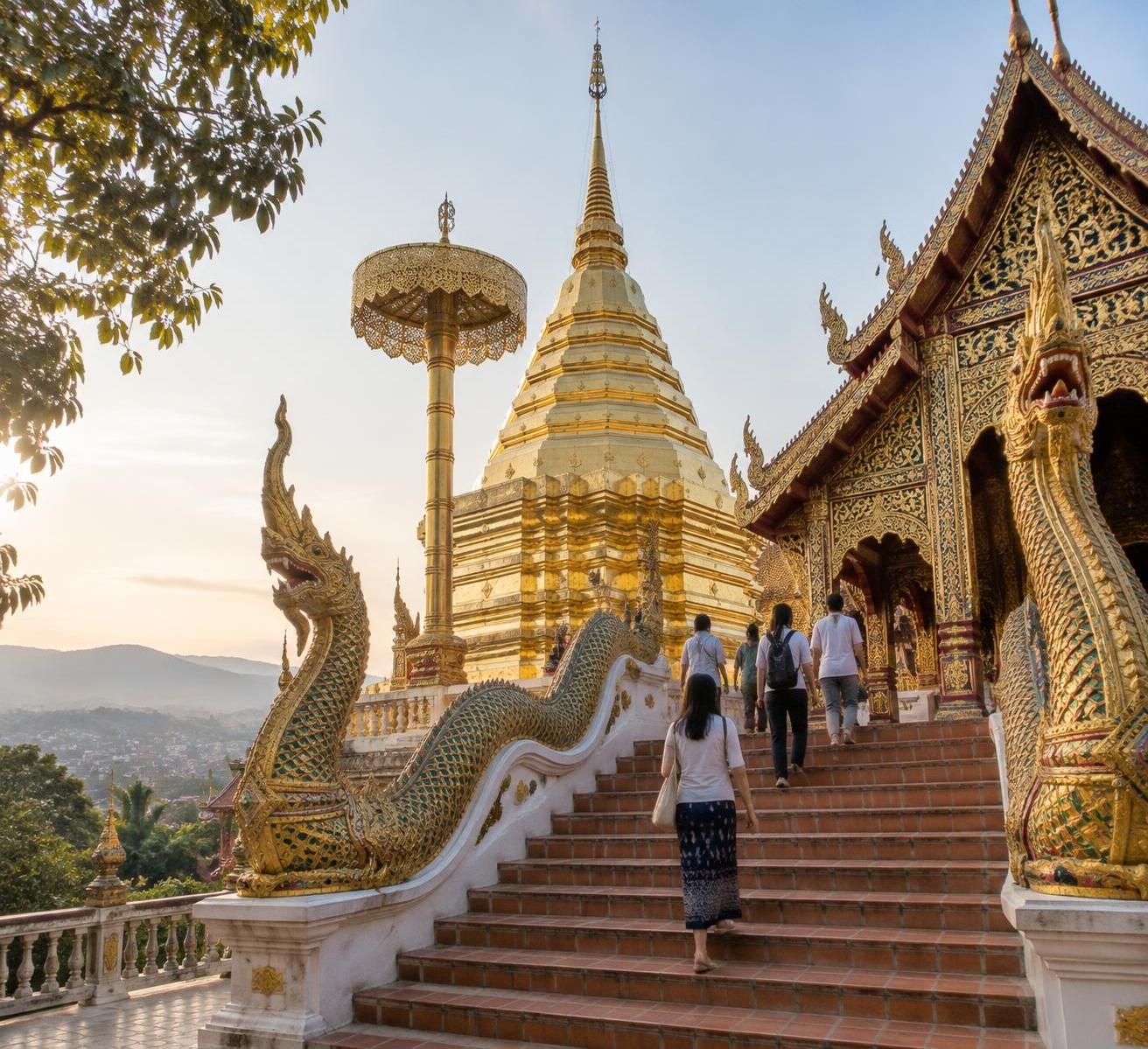
Wat Phra That Doi Suthep sits on the slopes of the mountain northwest of Chiang Mai, roughly 15 kilometers from the city. Its gleaming chedi, ceremonial terraces and views across the valley make it a rewarding choice for travelers who have time for only one journey beyond the Old City.
The temple is traditionally associated with a sacred Buddha relic and a white elephant said to have carried it up the mountain. The story connects the site to the religious history of the Lanna kingdom and helps explain why the journey is meaningful to pilgrims as well as visitors.
What to See at Wat Phra That Doi Suthep
A staircase lined with mosaic naga, or mythical serpents, leads toward the main complex. Published step counts differ slightly, but the climb is commonly described as approximately 300 steps; a funicular provides an alternative for travelers who prefer not to use the stairs.
At the top, the golden chedi draws attention immediately, especially when sunlight catches its surface. Take time to notice worshippers walking around the shrine, presenting offerings or pausing in prayer, and give them room rather than treating every ritual as a photo opportunity.
The viewing terrace offers a different perspective: on a clear day, the city spreads across the valley below. Visibility depends on weather and air quality, so a disappointing view does not diminish the temple’s religious significance or its detailed craftsmanship.
May chooses an early departure and arrives before the busiest part of the morning. That decision gives her a cooler climb and more space to look closely at the serpent balustrades, rather than navigating the staircase in a steady stream of tour groups.
Planning a Doi Suthep Visit
Red shared songthaews leave from areas around Chang Phueak and Chiang Mai University, although the fare depends on the departure point, passenger numbers and whether the vehicle is hired privately. Agree on the price and return arrangements before setting off; a ride booked through an app or a private driver can be simpler for a small group.
Foreign visitors have commonly paid around 30–50 THB for admission, with a separate charge for the funicular where applicable. Treat these figures as planning estimates rather than guaranteed 2026 prices, and check current signs before paying.
Early morning and late afternoon are useful choices for gentler temperatures, though opening arrangements and transport availability should be checked on the day. Carry water, cover shoulders and knees, and be prepared to remove shoes in designated sacred areas.
For a more contemplative mountain outing, Wat Pha Lat can be paired with Doi Suthep by road or by hiking part of the Monk’s Trail. It is not necessary to attempt both, however: allowing a full half-day for the main temple makes the trip feel like a pilgrimage rather than a transport exercise.
Wat Chedi Luang and Wat Phra Singh: Old City History and Art
The Old City’s most rewarding pairing is not a competition between two famous names. Wat Chedi Luang gives scale and historical weight to a walking route, while Wat Phra Singh invites closer attention to painting, woodwork and devotional life.
Their central locations make them practical for a first morning in Chiang Mai. May walks between them with a water stop in between, leaving enough time to sit quietly rather than treating each courtyard as another item to tick off.
Wat Chedi Luang’s Monumental Brick Chedi
At Wat Chedi Luang, the great chedi rises above the surrounding buildings with a weathered brick mass that feels very different from the polished gold of Doi Suthep. It was damaged in the sixteenth century, commonly associated with an earthquake, and has undergone partial restoration without returning to its former height.
The result makes temple history visible in the structure itself. Instead of a seamless recreation, visitors can see the contrast between the surviving monument and later conservation work, while imagining its former importance in the Lanna capital.
The complex was once home to the revered Emerald Buddha, now housed in Bangkok. It also contains the Inthakhin city pillar shrine, a place of particular importance to Chiang Mai’s civic and spiritual traditions; signs at individual buildings explain any access restrictions.
One of the most useful experiences here is monk chat, where visitors may speak with monks practicing English. Availability changes, so check at the temple rather than building a tightly timed itinerary around a session.
A thoughtful conversation can begin with an open question about daily routines, study or temple life. Listen as carefully as you speak, avoid intrusive personal questions and remember that the exchange is a conversation between people, not a performance arranged for a camera.
Wat Phra Singh’s Murals and Lanna Craftsmanship
Wat Phra Singh is associated with the revered Phra Buddha Sihing image and remains an active center of worship. Its buildings reward a slower visit than a quick photograph at the entrance: look for layered roofs, carved details and the contrast between expansive halls and intimate chapels.
Wihan Lai Kham is especially admired for gilded woodwork and murals. The paintings bring local stories and earlier ways of life into view alongside religious themes, giving visitors a way to connect artistic detail with the people who sustained the temple.
May spends several minutes observing a mural rather than trying to photograph every panel. That pause makes the craftsmanship easier to appreciate and leaves room for worshippers moving through the building.
Foreign admission charges at major Old City temples have often been around 40–50 THB, but fees can differ by area and change over time. Check the current notice at each entrance, carry small notes and do not assume that a price listed on an older travel page applies to the entire complex.
Nearby Wat Phan Tao offers another useful contrast with its distinctive teak assembly hall. Together, these stops show how a short walk can move from monumental brickwork to painted interiors and timber craftsmanship without requiring a packed schedule.
Wat Chiang Man and Lanna Architecture: Reading the City’s Past
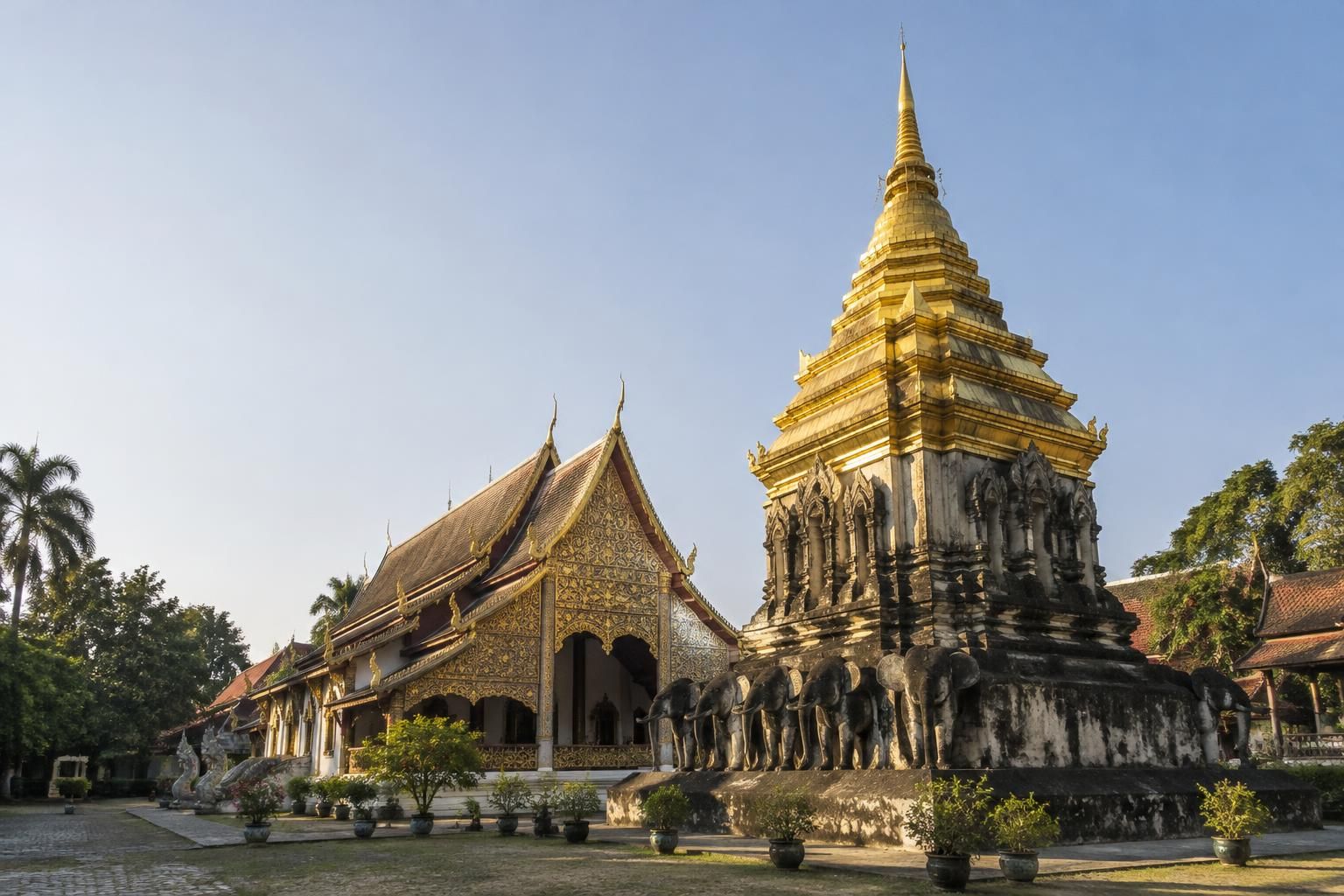
Wat Chiang Man, founded in 1296 around the time Chiang Mai was established, is traditionally regarded as the city’s oldest temple. It offers a quieter historical stop than the busiest Old City sites and is particularly rewarding for travelers who want to understand the foundations of the former Lanna capital.
May adds it to her route after visiting the larger temples, when the shade and less hurried atmosphere are welcome. The change of pace also makes it easier to notice details that might otherwise blend together after several ornate buildings.
Elephants, Buddha Images and Early Chiang Mai
The temple’s elephant-supported chedi, often called Chang Lom, is its most recognizable feature. Sculpted elephants appear around the base, giving the impression that they support the structure above and creating a strong visual link between architecture, symbolism and royal culture.
Two small Buddha images associated with the site, commonly known as the Crystal Buddha and the Marble Buddha, are significant objects of local devotion. Access to the building where they are kept can vary, so follow posted instructions and avoid assuming that every sacred object will be on public view.
There is generally no fixed admission charge, although donations are welcome. This makes the site an approachable stop for budget-conscious travelers, but a free entrance should not be mistaken for an invitation to overlook signs, interrupt worship or treat the grounds casually.
When looking at the chedi, May moves around it slowly to see how the elephants, brickwork and upper section relate to one another. The structure becomes more than a backdrop: it is a reminder that a temple complex can preserve evidence from different stages of a city’s life.
How to Recognize Lanna Architecture
Lanna architecture developed within the northern kingdom whose historical center was Chiang Mai. Although individual buildings have been repaired or rebuilt over time, recurring features help distinguish the regional tradition from the styles many visitors first encounter in central Thailand.
Look for layered roofs with deep eaves, carved timber, gilded ornament and naga motifs along stairs or rooflines. These features are not a rigid checklist: materials and decoration vary according to a building’s purpose, age and later restoration.
Wat Phra Singh’s Wihan Lai Kham offers an excellent comparison with Wat Chiang Man. The former draws attention to an elaborately decorated assembly hall, while the latter’s elephant chedi emphasizes the monumental form of a shrine.
At Wat Phan Tao, timber construction adds another texture to the Old City walk. Seen together, the buildings make the regional vocabulary easier to read, turning an apparent repetition of temples into a series of distinct design choices.
A guide can explain details that signs do not cover, including the subjects of murals and the roles of different buildings. Independent visitors can still have a meaningful experience by allowing time to observe, reading available information and asking respectful questions where conversation is welcome.
For broader planning ideas beyond the temple route, explore more Thailand travel inspiration. The most useful preparation is not memorizing every architectural term, but arriving ready to notice how form and local devotion fit together.
Wat Umong and Quieter Chiang Mai Temples Beyond the Walls
After the Old City’s busy lanes, Wat Umong changes the rhythm of a temple visit. Its wooded setting near Chiang Mai University, brick meditation tunnels and older chedi offer a more shaded, reflective experience than the exposed courtyards of central Chiang Mai.
The tunnels are associated with meditation and lead visitors through dim passages toward sacred images. Walk slowly, give others space and allow your eyes to adjust; the atmosphere depends as much on quiet behavior as on the architecture itself.
Forest Temples: Wat Umong and Wat Pha Lat
Above ground at Wat Umong, paths pass through trees toward a pond and other parts of the grounds. Recorded Buddhist teachings may be played around the site, contributing to its reputation for “talking trees,” though the experience can change with local arrangements.
Entry has commonly been free, with donations encouraged. The setting is cooler under the canopy than many open courtyards, but insect repellent, drinking water and shoes suited to uneven paths are sensible additions to a day bag.
Wat Pha Lat provides another forest setting on Doi Suthep’s slopes. It can be reached by road or on foot via the Monk’s Trail, making it a flexible companion to the larger mountain shrine rather than a place accessible only to hikers.
The trail offers a pleasant sense of leaving the city behind, but conditions matter. Wear shoes with grip, carry water and check recent local advice after rain, when roots and soil can become slippery; travelers who prefer to conserve energy can arrange road transport instead.
May chooses Wat Umong on the afternoon of her mountain day because she wants a quiet walk without committing to a hike. Someone who enjoys trails might make the opposite choice and give Wat Pha Lat more time, but neither stop needs to be squeezed into an already tiring itinerary.
White Chedis, Silverwork and Local Craft
Wat Suan Dok, west of the Old City, is known for its white memorial chedis and a prominent golden chedi. The white structures are associated with the remains of members of Chiang Mai’s former ruling family, making the grounds a place to consider the relationship between local history, remembrance and Buddhist practice.
The temple has also hosted monk chat sessions. As with other programs, confirm the current schedule locally and approach the exchange with curiosity rather than an expectation of guaranteed availability.
South of the Old City, Wat Sri Suphan reflects the metalworking heritage of the Wualai neighborhood. Its silver-colored ordination hall is covered in intricate panels made using metals including aluminum and silver; looking closely reveals the labor behind the striking overall effect.
Women are not permitted inside the ordination hall under the temple’s stated traditional restriction. Visitors who find that rule uncomfortable can still consider it when deciding whether to visit, and the exterior craftsmanship remains visible from the grounds.
These quieter sites work best as alternatives chosen for a reason: forest and tunnels at Umong, a hillside walk at Pha Lat, remembrance at Suan Dok or metalwork at Sri Suphan. Choosing one that matches the available time leaves room for the practical details that make any temple day easier.
Chiang Mai Temple Visiting Tips: Routes, Costs and Etiquette
A comfortable route begins with geography rather than a long list of names. Wat Chiang Man, Wat Chedi Luang and Wat Phra Singh are all in or near the Old City and can be linked on foot, while Doi Suthep requires a separate journey into the hills.
May divides her plan across two days: a walking morning for the central sites, then a mountain visit with Wat Umong if energy and transport arrangements allow. The separation reduces travel pressure and makes it easier to take a meal break or return to accommodation during the hottest hours.
Compare the Main Chiang Mai Temples
| Temple | Best known for | Planning note |
|---|---|---|
| Wat Phra That Doi Suthep | Golden chedi and mountain setting | Allow a half-day including transport. |
| Wat Chedi Luang | Ruined brick chedi and city history | Ask locally about monk chat times. |
| Wat Phra Singh | Murals and gilded Lanna woodwork | Allow time for the smaller halls. |
| Wat Chiang Man | Early city history and elephant chedi | Usually free to enter; donations welcome. |
| Wat Umong | Forest paths and meditation tunnels | Combine with a west-of-city outing. |
Walking between central stops is inexpensive, but heat and uneven pavements can make a short ride worthwhile. Shared songthaews and app-booked cars offer alternatives; confirm the fare before boarding a songthaew and agree whether a quoted price is per person or for the vehicle.
Admission at the major paid sites has often been in the tens of baht, while Wat Chiang Man and Wat Umong have generally operated without fixed entrance fees. Set aside extra cash for changing charges, transport, water and optional donations rather than relying on a precise total from an older guide.
Temple Etiquette and Respectful Visits
Temple etiquette begins before entering a hall: cover shoulders and knees, dress respectfully and remove shoes wherever signs or local practice indicate. A lightweight long-sleeved layer and loose trousers are practical in warm weather, and a scarf can be useful when additional coverage is needed.
Inside, keep voices low and avoid pointing feet toward Buddha images or worshippers when seated. Photography rules differ by building, so check signs, avoid flash where prohibited and ask permission before photographing people.
When interacting with monks, be courteous and follow local guidance about physical contact. Women are generally expected not to touch monks or hand objects directly to them; placing an item where the monk can pick it up is a respectful alternative when appropriate.
Visitors do not need to be Buddhist to enter welcoming public areas, but these are active places of Buddhist culture, not simply museums. Step aside during ceremonies, respect restricted spaces and remember that a quiet moment can be as valuable as a photograph.
Weather, Timing and Guided Visits
November through February generally brings cooler conditions that make walking more comfortable. During the smoky season, often affecting late winter and spring, air quality can deteriorate and mountain views may be obscured; check current local air-quality information before planning strenuous outdoor activity.
A guide is optional at the principal temples, which can be visited independently. The value of hiring one lies in context and logistics: a good local guide can explain mural stories, religious customs and architectural details while adapting the route to the group’s needs.
Travelers planning a longer stay can use this Thailand travel resource alongside current local transport and temple information. Whether the day includes two stops or five, the most useful visiting tip is to leave enough space for worship, weather and the unexpected.