

A late arrival at a hostel, a quick meal from a street stall, or a journey across town can all become easier with a few well-chosen Thai words. A greeting opens the exchange, a polite request gives it direction, and a phrase such as “please speak slowly” leaves room for both people to understand each other.
Everyday Thai phrases do not need to be long to be useful. Thai often leaves out information that is clear from the situation, so a short sentence, a gesture, and the name of a destination can communicate plenty. Pronunciation and politeness matter, but beginners can start before every sound feels perfect.
At a glance
- Start with สวัสดี for hello and ขอบคุณ for thank you.
- Use polite sentence endings that reflect the speaker, and listen for the difference between statements and questions.
- Learn a few practical phrases for food, transport, prices, and moments when communication breaks down.
- Keep important addresses and dietary information written in Thai when accuracy matters.
Thai Greetings and Introductions for Everyday Conversations
At a reception desk, a market stall, or a neighbor’s doorway, Thai greetings offer a comfortable way to begin. The most versatile expression is สวัสดี (sà-wàt-dee), which works for both “hello” and “goodbye.” Add a polite ending, make eye contact, and allow the other person a moment to respond.
For a first encounter, the complete greeting is commonly สวัสดีครับ (sà-wàt-dee khráp) for a male speaker or สวัสดีค่ะ (sà-wàt-dee khâ) for a female speaker. These particles reflect the speaker’s presentation, not the gender of the person being addressed. The same visitor can therefore use the same ending with a receptionist, a driver, and a shopkeeper.
Basic Thai Introductions and Friendly Responses
Suppose a newly arrived guest named Alex meets another traveler in a hostel kitchen. A simple ชื่อ Alex (chêu Alex) means “My name is Alex.” Thai frequently omits a pronoun when the context is clear, so this shorter form feels practical rather than incomplete.
To ask someone’s name, use คุณชื่ออะไร (khun chêu à-rai), meaning “What is your name?” A polite particle at the end makes the question gentler. Female speakers generally use คะ (khá) in a question and ค่ะ (khâ) in a statement; male speakers generally use ครับ (khráp) in both.
Another useful exchange begins with สบายดีไหม (sà-baai dee mái), or “How are you?” A reply can be สบายดี ขอบคุณ (sà-baai dee khàawp-khun), meaning “Fine, thank you.” Add แล้วคุณล่ะ (láew khun lâ), “And you?”, to invite the other person into the conversation.
These Thai introductions do not demand a long conversation. A guest checking in after an overnight bus may only manage a greeting and a name, and that is enough to establish a friendly tone. If the other person replies quickly, a smile and a request to slow down are more useful than pretending to understand.
Polite Thai Expressions for Thanks and Apologies
ขอบคุณ (khàawp-khun) means “thank you,” while ขอบคุณมาก (khàawp-khun mâak) adds “very much.” Both fit ordinary situations, whether someone carries a bag, explains the Wi-Fi, or hands over a meal. The word มาก means “very” or “a lot,” making it useful with other descriptions too.
For “sorry” or “excuse me,” use ขอโทษ (khǎaw thôot). It can acknowledge a small mistake, attract someone’s attention, or make room through a crowded aisle. Context does the work: a gentle voice and a gesture communicate whether the speaker needs help or is apologizing.
ไม่เป็นไร (mâi pen rai) can mean “never mind,” “no problem,” or “you’re welcome,” depending on the exchange. It is a reassuring response to a minor inconvenience, not a substitute for checking whether a serious problem has been resolved. These polite expressions help an interaction feel considerate; the next challenge is making sure both sides understand the details.

Thai Pronunciation and Phrases for Clearer Communication
A written phrase can look manageable and still sound unfamiliar when spoken aloud. Thai pronunciation depends on tones and vowel length as well as consonants, so a word pronounced with a different pitch or a shortened vowel can be heard as something else. A traveler does not need flawless speech, but listening closely makes each attempt more useful.
Thai has five tones, and they are part of a word rather than simply a way of expressing emotion. Romanized spellings offer a starting point, but systems vary: one guide may write a sound differently from another. The Thai script beside a phrase gives a useful reference when asking a speaker to confirm what a word means.
Hear the Difference Between Questions and Negatives
Two small words deserve particular attention. ไม่ (mâi) commonly means “not,” while ไหม (mǎi) turns many statements into yes-or-no questions. Their tones differ, and they can appear close together, making careful listening more useful than relying on English spelling alone.
For example, ไม่แพง (mâi phaeng) means “not expensive,” while แพงไหม (phaeng mǎi) asks “Is it expensive?” The difference changes the purpose of the sentence. Practicing the pair aloud helps a shopper notice how the question word works before using it in other settings.
Vowel length matters too. Rather than guessing from a written approximation, listen to a reliable recording or a Thai speaker, then repeat the whole phrase at a comfortable pace. Short, regular practice is easier to retain than a long session immediately before a journey.
Everyday Thai Phrases When Words Run Out
When a conversation moves too fast, ไม่เข้าใจ (mâi khâo-jai) means “I don’t understand.” Pair it with พูดช้าๆ หน่อย (phûut cháa cháa nòi), “Please speak slowly.” The word หน่อย softens the request, helping it sound less like an order.
Another useful explanation is พูดไทยนิดหน่อย (phûut thai nít nòi): “I speak a little Thai.” It sets realistic expectations without ending the exchange. If the answer is still unclear, พูดอีกที (phûut ìik thii) asks the person to say it again.
At a hostel desk, Alex might need the departure time for a morning ferry. After hearing a rapid answer, Alex can ask the staff member to repeat it, then request ช่วยเขียนหน่อย (chûay khǐan nòi), “Please write it down.” A written time can be checked again later, when the conversation is over and the lobby is busy.
The same approach helps when a name, price, or platform number matters. Point to the relevant detail, repeat what was understood, and let the other person correct it. A phone screen, map, or piece of paper can support the conversation without replacing the courtesy of asking.
เข้าใจ (khâo-jai) means “I understand,” but it is worth using only when the message is clear. A brief pause may feel awkward, yet it prevents missed transport and incorrect orders. Clear communication is not a performance; it is a shared process that becomes especially valuable when it is time to eat.
Basic Thai Phrases for Ordering Food and Drinks
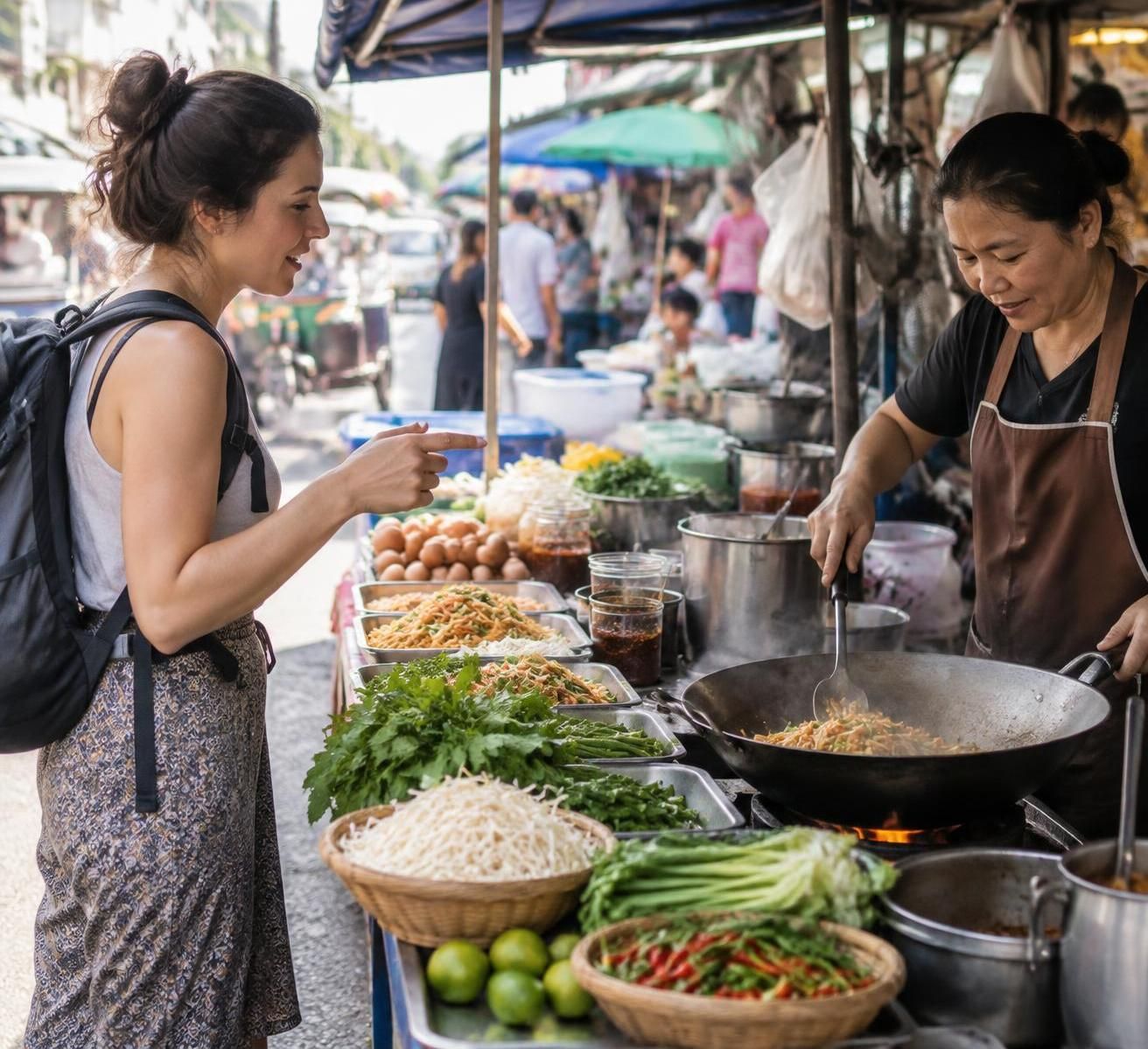
Street stalls and neighborhood restaurants can feel fast-moving, particularly when dishes are prepared in front of a queue. For ordering food, a few adaptable words are often more useful than a memorized speech. Begin by looking at the menu or pointing to a dish, then explain the most important preference clearly.
เอา (ao) can be used to request an item: say the word followed by the dish or drink, and finish with a polite particle. If the name is unfamiliar, pointing to a picture while using the same structure is a practical alternative. Confirming the selection before it is prepared gives the vendor a chance to correct any misunderstanding.
Ask About Spice, Ingredients, and Taste
ไม่เผ็ด (mâi phèt) means “not spicy,” referring to chili heat. By contrast, ร้อน (ráwn) describes something hot in temperature. The distinction matters when a bowl of soup is steaming but the customer wants no chili added.
To ask for less chili rather than none, เผ็ดนิดหน่อย (phèt nít nòi) means “a little spicy.” Preferences differ, however, and a cook’s idea of mild may not match a visitor’s. Someone who cannot tolerate chili should state the request clearly and check the finished dish before assuming it meets that need.
For an allergy, a short phrase alone may not be sufficient. A traveler with a peanut allergy can show a clearly written Thai message such as แพ้ถั่วลิสง, meaning “allergic to peanuts,” and ask for confirmation about ingredients and preparation. Shared utensils and sauces can also matter, so a conversation with the cook is important before eating.
For a drink without sugar, ไม่ใส่น้ำตาล (mâi sài nám-taan) means “do not add sugar.” If the drink comes from a premixed base, asking about the ingredients remains sensible. The phrase communicates a preference; it does not guarantee how every shop prepares its recipe.
Food Words That Keep a Conversation Going
Once the meal arrives, อร่อย (à-ròi) means “delicious.” A warm thank-you to the cook or server is an easy way to acknowledge the meal. If a companion asks อร่อยไหม (à-ròi mǎi), the question is “Is it delicious?”
Other pieces of basic Thai vocabulary describe how a person feels. หิวข้าว (hǐw khâao) means “hungry,” หิวน้ำ (hǐw náam) means “thirsty,” and อิ่มแล้ว (ìm láew) means “full.” These short phrases work well among companions deciding whether to order another dish or stop for a drink.
Imagine Alex choosing lunch after checking out of a hostel. Pointing to a noodle dish, asking for ไม่เผ็ด, and thanking the vendor creates a complete, manageable exchange. If a friend has an allergy, the written ingredient message comes before ordering, not after the plate arrives.
Menus also provide a chance to learn one item at a time. Notice a familiar word, listen when the vendor repeats it, and connect the sound to the dish in front of you. That small habit turns an ordinary meal into practice without interrupting the people preparing it.
The most useful food language identifies a need before the cooking starts and confirms it when the stakes are high. Once lunch is finished, the same combination of short phrases and visual context helps with the next task: finding the way onward.
Thai Phrases for Asking Directions and Taking a Taxi
Asking directions becomes easier when the destination is visible as well as spoken. Hotel names, street names, and landmarks can sound different from their English spellings, so keep the address in Thai on a phone or booking confirmation. The written name gives a driver or passerby something precise to check.
To ask where a place is, put its name before อยู่ที่ไหน (yùu thîi nǎi), meaning “Where is it?” For example, ห้องน้ำอยู่ที่ไหน (hông-náam yùu thîi nǎi) asks “Where is the toilet?” The same pattern works with โรงแรม (rohng-raem), “hotel,” or ตลาด (dtà-làat), “market.”
Useful Direction Words in Thai
Directions often arrive as a sequence, so recognizing a few landmarks and turns can be more useful than understanding every word. The following expressions give a beginner a workable starting point for a short journey.
| English | Thai | Approximate pronunciation |
|---|---|---|
| Go straight | ตรงไป | dtrong bpai |
| Turn left | เลี้ยวซ้าย | líeow sáai |
| Turn right | เลี้ยวขวา | líeow khwǎa |
| Stop here, please | จอดที่นี่ ค่ะ/ครับ | jàwt thîi nîi khâ/khráp |
| Traffic lights | ไฟแดง | fai daeng |
Before stepping into a taxi, show the destination and confirm that the driver recognizes it. For an app-booked ride, check the pickup point as well: a map pin on the opposite side of a busy road can create confusion even when the destination is correct. A short message in Thai or a visible landmark may help both parties find each other.
During the journey, ไป (bpai) means “go” and can be followed by a destination. If Alex needs to reach a market, showing its name and saying the destination after ไป gives the driver both a spoken cue and a written reference. When the vehicle approaches the entrance, จอดที่นี่ asks the driver to stop there.
Check Distance and Clarify the Route
ไกลไหม (glai mǎi) asks “Is it far?” and ใกล้ไหม (glâi mǎi) asks “Is it near?” The words for “far” and “near” look and sound similar in romanization, so listen to the vowel and tone rather than assuming they are interchangeable. A map can help confirm which meaning was intended.
If someone describes several turns at once, ask for a slower explanation or request that the route be shown on a map. Repeating “left” or “right” while pointing in the intended direction gives the speaker an opportunity to correct the route. This is particularly helpful at unfamiliar junctions where signs may be difficult to read quickly.
For a longer trip, a destination address is more dependable than a hotel name alone, especially when businesses have similar names. Keep the phone charged, save the booking details for offline access when possible, and ask staff to write a landmark if the entrance is hard to find. A polite question supported by a clear address reduces guesswork for everyone, leaving more attention for the stops along the way.
Thai Shopping Phrases, Common Questions, and Essential Help
A market conversation may begin with a smile and a glance at an item, but prices and quantities deserve a clear answer. Shopping phrases built around เท่าไหร่ (thâo-rài), “how much?”, are useful at stalls, small shops, and ticket counters. Point to the object while asking so the seller knows exactly which price is needed.
กี่บาท (gìi bàat) means “How many baht?” and is another direct way to ask a price. If several items are involved, separate them or indicate the quantity before confirming the total. A displayed calculator can be helpful when spoken numbers are unfamiliar, particularly in a noisy market.
Common Questions for Shops and Everyday Needs
To ask whether something is available, use มี (mii), the item, and ไหม (mǎi). For example, มีน้ำไหม (mii náam mǎi) asks “Do you have water?” The response มี means it is available, while ไม่มี (mâi mii) means it is not.
This pattern is more useful than memorizing a separate sentence for every purchase. Replace the item with a product name, show a picture, or point to an empty shelf. The seller can then answer the specific question rather than guessing what the customer needs.
Other common questions use อะไร (à-rai), “what,” and เมื่อไหร่ (mûea-rài), “when.” นี่อะไร (nîi à-rai) means “What is this?” and can prompt an explanation of an unfamiliar snack or ingredient. For a departure time, a written schedule remains valuable because understanding “when” is only the first step.
If Alex picks up a woven bag at a market, asking the price before discussing a purchase keeps the interaction straightforward. If bargaining is customary at that stall, a respectful offer may open a conversation; fixed-price shops and clearly marked goods may not invite negotiation. Accepting the answer graciously matters more than turning every purchase into a contest.
แพง (phaeng) means “expensive,” and ไม่แพง (mâi phaeng) means “not expensive.” These are useful descriptions, but announcing that an item is expensive can sound abrupt. A polite question about the price, followed by a simple decision, is often a smoother approach.
Thai Phrases for Feeling Unwell or Needing Help
Practical language also includes words for situations nobody plans to encounter. ไม่สบาย (mâi sà-baai) means “unwell,” and หลงทาง (lǒng thaang) means “lost.” Showing a destination or explaining the immediate need can help someone decide what assistance to offer.
In an urgent situation, ช่วยด้วย (chûay dûay) means “Help!” and ตำรวจ (dtam-rùat) means “police.” If medical care is needed, seek a hospital or emergency assistance promptly rather than relying on a phrase list to describe symptoms accurately. A written note about allergies or medication can help communicate important details.
A receptionist, shopkeeper, or passerby may be able to help locate a service, but the clearest request identifies what is needed: a doctor, directions, or help contacting someone. If the response is difficult to follow, ask for it to be written down or shown on a map. In a stressful moment, a few precise words and a visible piece of information can make the next step much easier to understand.