
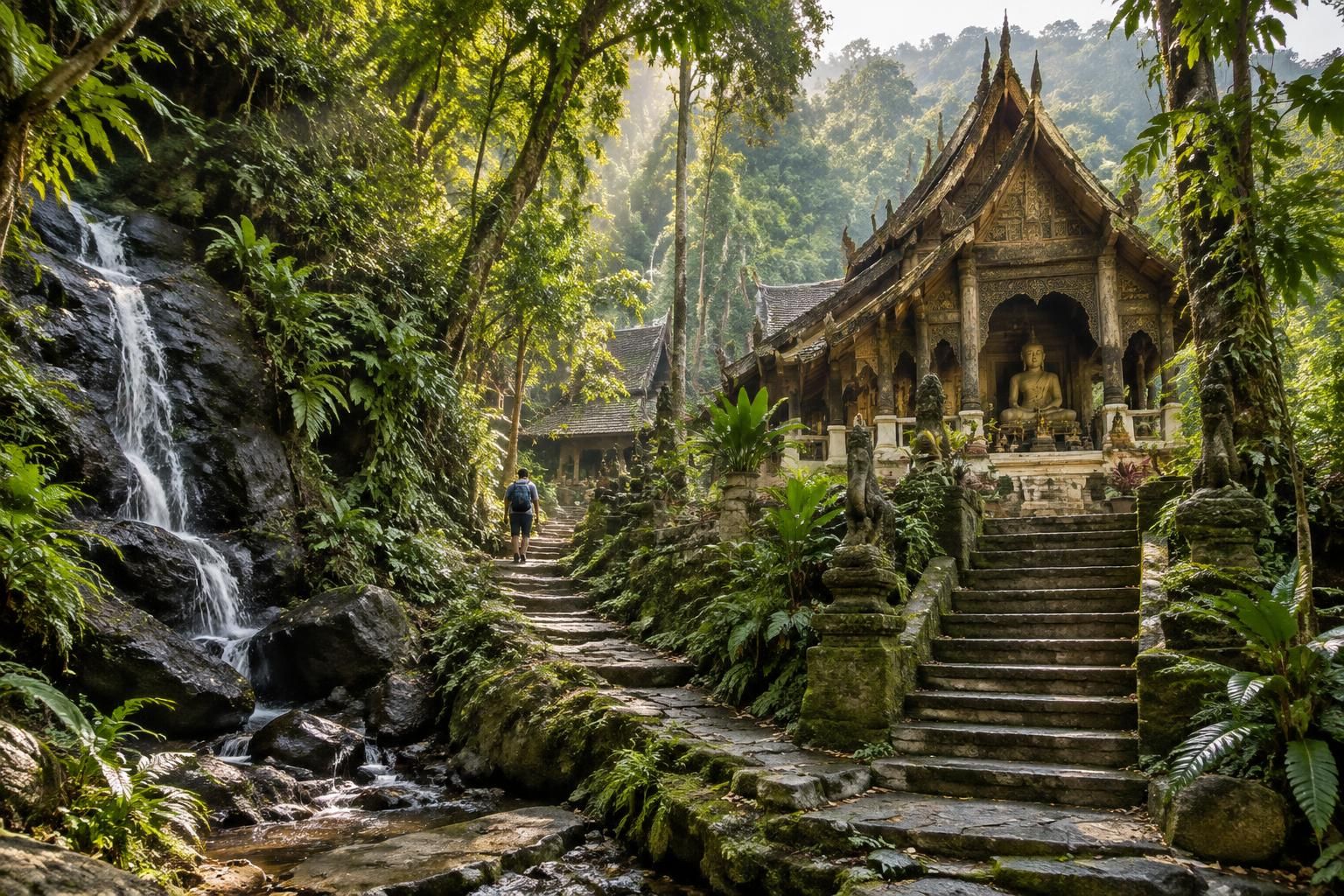
On the wooded slopes above Chiang Mai, Wat Pha Lat sits beside a stream, where stone stairways, shrines and tree roots share the hillside. Some visitors arrive by road and spend an unhurried hour among the temple buildings; others make the journey part of the experience, following the shaded Monk’s Trail through the forest.
The choice makes this Chiang Mai temple accessible to different kinds of travelers, though the walking route calls for more preparation than its short distance suggests. A little planning also helps preserve the atmosphere that makes the site special: this is an active place of worship, not simply a viewpoint or a stop on the way to Doi Suthep.
At a glance
- Setting: A forest temple on the slopes of Doi Suthep, west of Chiang Mai.
- Getting there: Travel by road or walk the Monk’s Trail from the foothills near Chiang Mai University.
- Hike: Approximately 1.6 km each way, with around 200 meters of ascent and uneven ground.
- Highlights: Mossy stonework, Buddhist shrines, forest paths, a stream and views toward the city.
- Bring: Water, grippy shoes and clothing that covers shoulders and knees.
- Before setting out: Check current access arrangements, weather and transport prices locally.
What to See at Wat Pha Lat: Shrines, Stonework and Forest Views
Wat Pha Lat rewards the visitor who slows down. Rather than presenting one grand building at the center of a formal courtyard, the grounds unfold along a wooded slope, with small structures and stone paths appearing between trees. Running water adds movement to the scene, while weathered surfaces reveal how closely the site belongs to its surroundings.
A first-time visitor such as Maya, a fictional traveler spending a few days in Chiang Mai, might be tempted to head straight for the most photogenic staircase. Taking a few minutes to look around first makes the layout easier to understand and helps her notice worshippers, narrow paths and areas where a quiet approach is appropriate.
Wat Pha Lat’s Buddhist Architecture and Stone Guardians
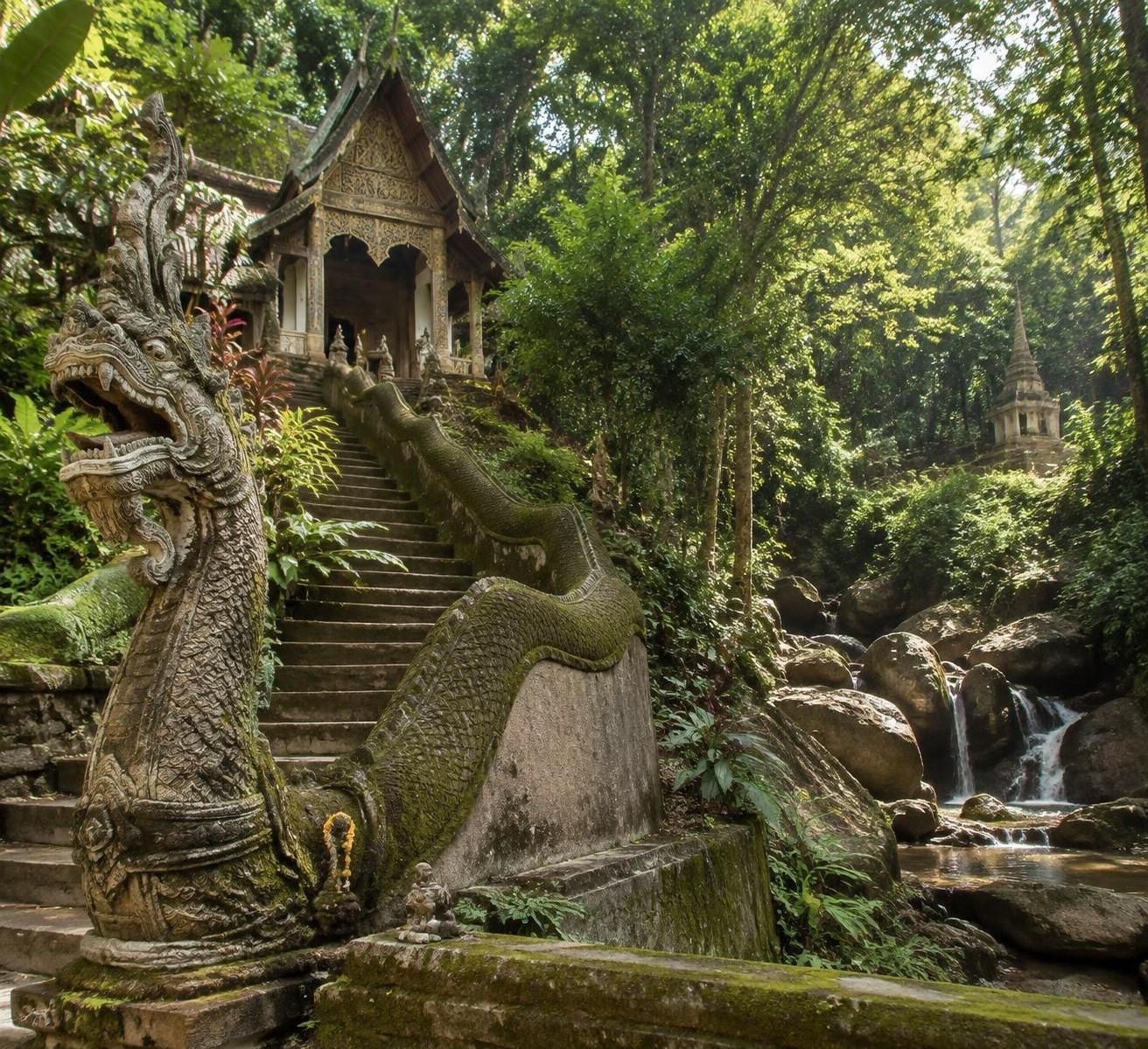
The temple’s Buddhist architecture includes shrines and religious structures set among older-looking stone features, statues and flights of steps. Look for naga imagery: these serpent figures have an important place in Buddhist traditions across the region and often appear as protective presences beside temple stairways. Their curved forms are especially striking against the foliage.
Not every detail needs a precise historical label to be appreciated. Notice how carved edges, moss and exposed rock sit beside maintained places of worship: the contrast shows that the grounds are both a living religious site and a place shaped by the mountain environment. Avoid climbing on decorative figures or moving objects to improve a photograph.
Some buildings may be open while others are closed or reserved for particular activities. If an entrance is accessible, pause to check for shoe racks, posted instructions or people praying before stepping inside. A respectful look from outside is worthwhile when an interior is unavailable.
The Stream, Jungle Waterfall and Chiang Mai Views
Water is one of the defining features of the site. A stream runs through the grounds and over the sloping rock, creating small cascades that can look very different according to recent rainfall. The phrase jungle waterfall captures the setting, but visitors should not expect a powerful flow in every season.
After rain, water and green vegetation bring the hillside to life, but wet rock can be treacherous. Stay on established walkways, keep a comfortable distance from edges and resist the urge to enter the stream for a photograph. A dry spell, meanwhile, can reveal rock formations and details that are harder to see when water is high.
Openings in the trees offer views across Chiang Mai, although haze, humidity and cloud can soften or obscure the city. For Maya, a clear view is a welcome bonus rather than the only reason for visiting; the sounds of water and insects remain part of the experience even when visibility is poor.
Allow time to sit quietly where visitors are welcome, keeping paths clear for others. The most memorable detail may be a modest one: a stone figure half framed by leaves or the sound of water beneath a stairway. Understanding that gentle pace also helps when choosing how to arrive.
How to Get to Wat Pha Lat from Chiang Mai by Road
Reaching Wat Pha Lat by road is the simplest choice for travelers who want to save their energy for exploring the grounds. The temple lies on the mountain road toward Doi Suthep, west of the city, with a turnoff leading down to the forest complex. Travel time depends on the starting point and traffic, so leave room in the schedule rather than treating a short map distance as a fixed journey time.
A road arrival can suit families, travelers with limited time and anyone who would rather avoid a steep dirt trail. It does not make the entire visit step-free, however: paths and stairs within the grounds can still be uneven, and damp surfaces require care.
Using a Driver, Ride-Hailing App or Red Songthaew
A car with a driver or a ride-hailing service offers a straightforward door-to-door option. Enter the temple name carefully, check that the destination is Wat Pha Lat rather than Wat Phra That Doi Suthep higher up the mountain, and confirm the meeting point before departure. The spelling “Wat Pha Lad” also appears on maps and signs.
Before accepting a fare, Maya checks whether it covers a one-way ride, waiting time or a return journey. That small conversation matters because transport back to town can be less convenient than transport from it. If arranging a pickup later, she notes the agreed location and allows extra time in case a driver is not immediately nearby.
Red songthaews, the shared pickup-style vehicles seen around Chiang Mai, can also be useful. Explain the destination clearly and agree on the price and any waiting arrangement before boarding; a privately negotiated trip and a shared ride are not necessarily priced alike. Carrying the temple name on a phone can help prevent confusion.
Some visitors combine the forest temple with Wat Phra That Doi Suthep on the same mountain road. That can work well with a driver, but it is worth agreeing on separate stops and realistic waiting times. A hurried photo break at the lower temple leaves little opportunity to appreciate its paths and shrines.
Driving or Riding a Scooter to the Temple
Independent travelers can use the mountain road, but its bends, changing traffic and occasional wet patches deserve attention. A scooter is best left to riders who are experienced, appropriately licensed and comfortable with local conditions. Helmets, suitable insurance and a vehicle in good working order are practical essentials, not optional extras.
Watch for the turnoff rather than relying on a last-second maneuver, and park only in appropriate areas without blocking access. In rain or poor visibility, a car with a local driver can be a more comfortable choice. Anyone traveling after dark should also consider the difficulty of navigating an unfamiliar mountain road.
Road access offers flexibility, but the approach changes the character of the visit. For travelers who enjoy a steady climb and have suitable footwear, the alternative begins not at the temple gate but in the forest below.
Monk’s Trail to Wat Pha Lat: Route, Distance and Hiking Conditions
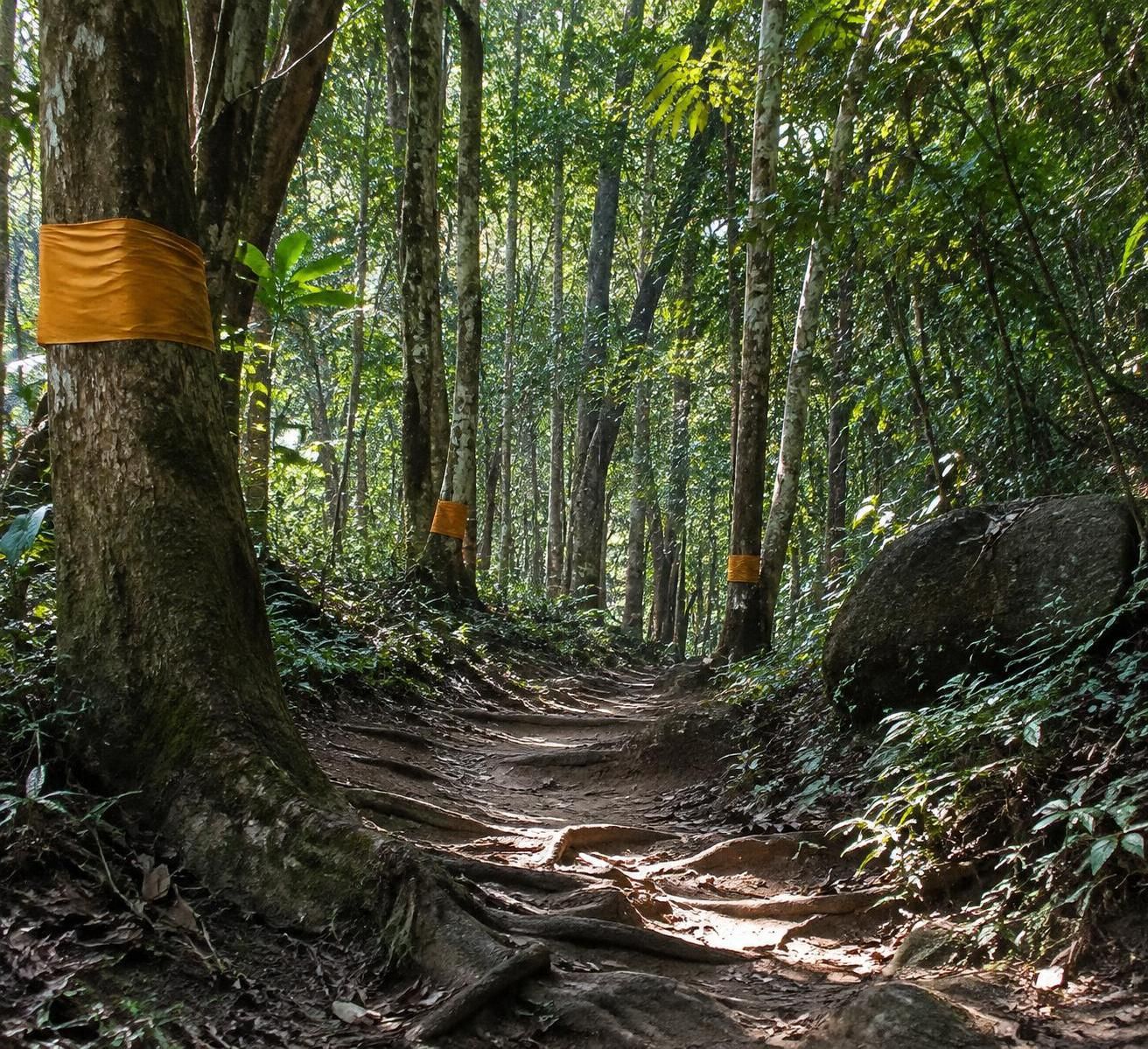
The Monk’s Trail is a short mountain walk with a rewarding destination, not a flat stroll through a city park. It climbs through forest toward Wat Pha Lat on a natural path of dirt, roots, rocks and occasional steps. The route is often described as easy to moderate, though the uphill gradient can feel demanding in heat or humidity.
For Maya, the appeal is arriving gradually: traffic noise fades, vegetation closes around the path, and the temple appears after the climb rather than immediately after a car journey. That experience comes with a trade-off. She needs to carry water, choose shoes carefully and leave enough daylight for the return.
Finding the Monk’s Trail Trailhead
The usual starting point is near the foothills behind Chiang Mai University, in the Wat Fai Hin area. Ask a driver for the Monk’s Trail trailhead to Wat Pha Lat, rather than simply asking for Wat Pha Lat, because the temple itself is reachable by road. Check the route on a map before leaving and confirm the current entrance locally.
Wat Umong is another well-known forest temple in the wider area, but it should not be treated as the walking trailhead. Distinguishing the two is especially useful when arranging a pickup: a pin placed at the wrong temple can add unnecessary travel before the hike even begins.
| Trail detail | Planning estimate |
|---|---|
| Route | Out and back to Wat Pha Lat |
| Distance | About 1.6 km each way |
| Elevation gain | About 200 meters on the ascent |
| Walking time | Roughly 1–1.5 hours round trip, depending on pace |
| Surface | Dirt, exposed roots, rocks and stone steps |
These figures are useful for planning rather than a promise of a particular finish time. Add separate time for photographs, rest and exploring the temple, especially when walking with children or anyone who prefers a gentler pace.
What the Climb Feels Like
The lower section starts with a comparatively gradual rise beneath trees and bamboo. Farther up, the path becomes steeper and more irregular, with roots forming natural steps and rocks requiring careful foot placement. Shorter, flatter stretches give walkers a chance to pause without blocking the route.
Pieces of saffron-colored cloth tied to trees are associated with the historic route used by monks and are a distinctive sight along the way. They can help with orientation, but should not be treated as a substitute for checking the route: markers can change, and a downloaded map is useful if phone reception is unreliable.
Near the destination, wider paths and stone steps bring the temple setting into view. Running water may be audible before the buildings are obvious, although its volume varies with the season. Take extra care on the descent, when loose soil and wet roots can be more difficult than they were on the way up.
The trail can continue toward Wat Phra That Doi Suthep, but that extension is a more demanding undertaking rather than a casual addition to the short temple hike. For a first visit, deciding on the return point before starting makes it easier to match the walk to the day’s weather, energy and available light.
Best Time to Visit Wat Pha Lat and Prepare for the Weather
Timing affects much more than the color of the photographs. Heat, rain, air quality and daylight all influence how comfortable the journey feels, particularly for visitors walking uphill. A flexible plan allows the mountain to be enjoyed without forcing a strenuous outing into unsuitable conditions.
Early morning is often a comfortable choice for the climb, before the day becomes hotter and while the forest is relatively quiet. Maya leaves enough time for breakfast, fills her water bottle and starts with no pressure to maintain a fast pace. A late-afternoon visit can also be pleasant, but only if there is sufficient daylight for a safe return.
Cool Season, Rain and Seasonal Haze
The cooler part of the year generally brings more comfortable walking temperatures and can offer clearer views across the valley. Conditions still vary from day to day, so a light layer may feel welcome early on even when the climb later becomes warm. Start gently rather than assuming shade will make the ascent effortless.
During the rainy season, the surrounding vegetation can look especially lush and the stream may be more active. The same rain also makes roots, rocks and steps slippery, and heavy downpours can make a forest walk less suitable. Check the forecast, avoid the trail during storms and consider road access when the ground is very wet.
Seasonal smoke and haze can affect Chiang Mai, particularly during the dry months. Check current air-quality readings before exercising outdoors; when pollution is high, postpone the hike or choose a less strenuous plan. A view from the temple is not worth pushing through uncomfortable breathing conditions.
What to Pack for a Comfortable Temple Hike
- Water: Carry enough for the climb, the return and any time spent exploring.
- Footwear: Choose shoes with grip and secure footing for roots, dirt and stone.
- Temple clothing: Cover shoulders and knees; a light layer can be carried in a daypack.
- Weather protection: Bring a compact rain layer when showers are possible.
- Navigation: Save the trailhead and route before setting off, and keep a charged phone.
- Small essentials: Consider insect repellent, sun protection and a bag for personal rubbish.
Pack for the activity rather than the distance alone. A traveler in smooth-soled sandals might find a short wet descent more difficult than expected, while someone with sturdy shoes and a little extra time can move more confidently. Trekking poles may help walkers who usually use them, provided they are handled carefully around other people and temple surfaces.
Food and drinks are best planned before departure rather than assumed to be available at the temple. Drink regularly, take breaks in safe spots and turn back if someone feels unwell or the conditions change. If traveling alone, sharing the intended route and expected return time with someone at the accommodation adds a useful layer of reassurance.
Preparation leaves more attention for the experience itself: birds in the canopy, a glimpse of the city and the changing sound of the stream. Once at the grounds, the next consideration is how to share that space respectfully with the people who use it for worship.
Wat Pha Lat Temple Etiquette and Practical Visiting Tips
Wat Pha Lat is a working Buddhist site as well as a visitor destination. Its peaceful atmosphere depends partly on people treating it as more than a scenic backdrop. Thoughtful temple etiquette is therefore practical as well as courteous: it helps worshippers, residents and travelers share paths and buildings comfortably.
Maya arrives after her hike in warm weather, so she pauses before entering the grounds to put on a light shirt over her walking clothes. The adjustment takes only a moment and means she can explore without worrying that her outfit is unsuitable for a religious setting.
Clothing, Shoes and Behavior at a Chiang Mai Temple
Dress modestly, with shoulders and knees covered, and follow any instructions displayed at the site. Lightweight clothing can make that easy in a warm climate; carrying a layer is useful when a hiking outfit leaves shoulders uncovered. Avoid relying on a garment being available to borrow.
Remove shoes where signs or local custom indicate, especially before entering a shrine or prayer space. If unsure, look for a shoe rack and follow posted guidance rather than copying someone who may not be entering the same area. Keep voices low, silence disruptive phone sounds and give people room to pray.
Be mindful of where feet are pointed when sitting near a Buddha image, and avoid touching sacred objects. Monks and other people at the site may be engaged in religious duties, so do not assume they are available for conversation or photographs. A friendly greeting is welcome when appropriate, but quiet observation is often the kinder choice.
Families can prepare children by explaining that the visit is both an outdoor outing and time in a place of worship. Asking them to walk rather than run on narrow paths protects other visitors as well as the children themselves. If a small child needs a break, find a suitable spot away from a shrine entrance or busy staircase.
Photography, Access and Responsible Planning
Photography can be part of the visit without taking over the visit. Step aside for people using the path, ask permission before photographing individuals closely and observe any restrictions around interiors or ceremonies. Never move offerings, stand on a statue or block a worshipper’s view to create a cleaner frame.
Keep personal belongings and rubbish with you, and avoid feeding wildlife or picking plants. The appeal of a forest temple lies in its relationship with the surrounding landscape, so even small actions on the paths and around the stream matter. Staying on established routes also reduces the chance of damaging vegetation or slipping on unstable ground.
Opening arrangements, access restrictions and any charges can change, so check reliable local information shortly before visiting rather than building a tight schedule around an old listing. Travelers with mobility concerns should ask specifically about steps, slopes and vehicle drop-off points; road access reduces the climb but does not remove every obstacle.
Before leaving, confirm the return plan: walk back down while there is enough light, meet the driver at the agreed point or allow time to arrange a ride. A useful travel guide does more than get someone to a landmark; it helps them leave the place as calmly and considerately as they found it.