
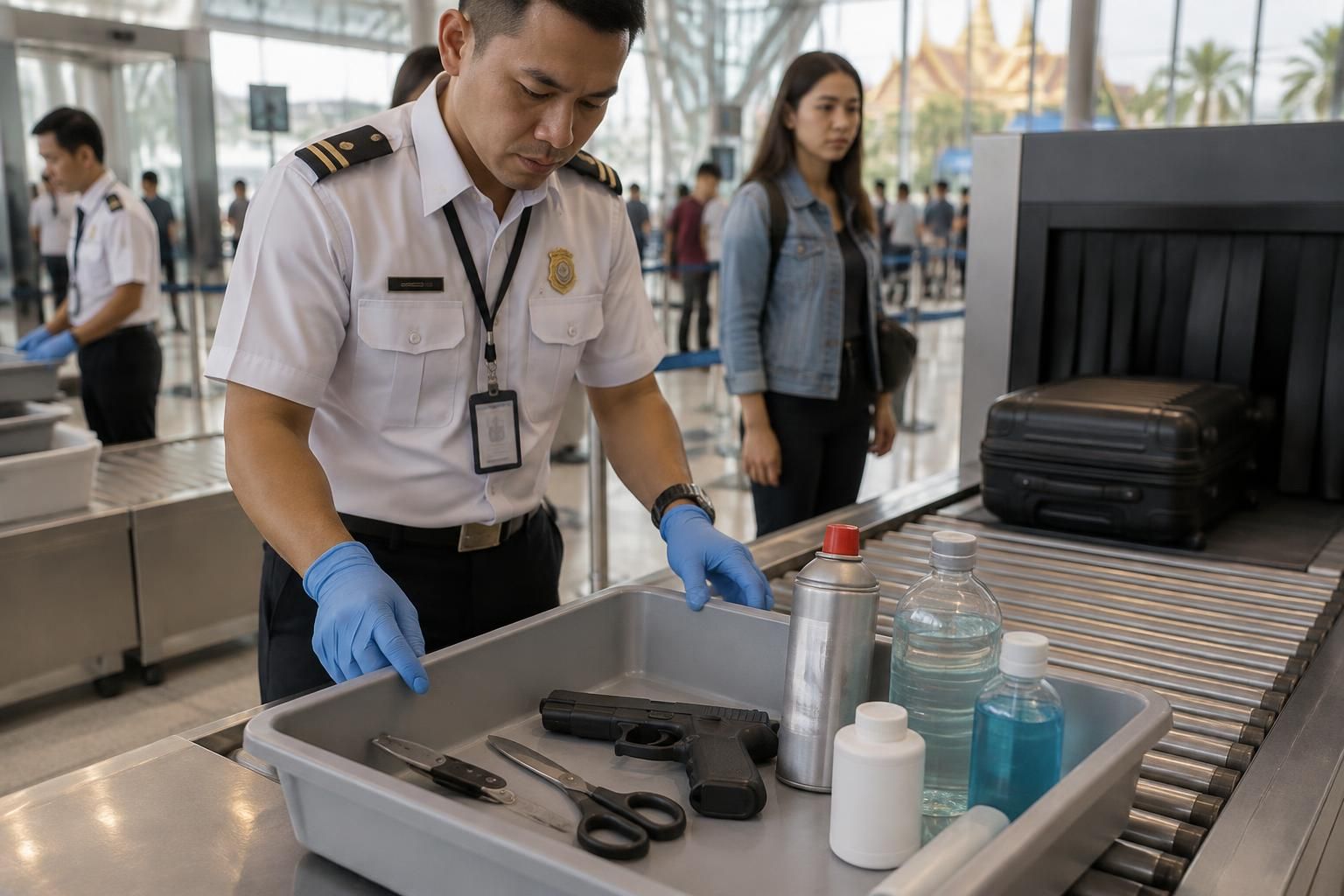
A forgotten vape, a loose battery or an unfamiliar prescription can turn a straightforward arrival in Thailand into an anxious conversation at the airport. The difficulty is that several rulebooks apply at once: aviation security controls what can fly, airlines set their own conditions, and customs officials enforce Thai import rules after landing.
Thailand airport prohibited items include goods that should not be packed at all, while other belongings are permitted only in a particular bag or with official authorization. A power bank, for example, belongs in the cabin; moving a vape into the cabin does not make it legal to import. Understanding that distinction helps travelers avoid the stressful last-minute reshuffle at the check-in counter.
At a glance
- Do not bring vapes, e-cigarettes or related products into Thailand.
- Keep power banks and spare lithium batteries in cabin baggage, subject to airline limits.
- Check whether prescription medicines, food, plants or animal products need authorization before departure.
- Separate airport security requirements from customs rules: permission to fly with an item is not necessarily permission to import it.
- Check current airline and airport instructions before traveling, including the procedures for checked-baggage inspections.
Thailand Airport Prohibited Items: Vapes, Drugs and Customs Bans
Thai customs officers distinguish between goods that are prohibited and goods that are restricted. Prohibited goods cannot legally be brought in, while restricted goods may be allowed only when the traveler has obtained the necessary permission or met specific conditions.
This distinction matters because airport customs regulations operate separately from the security check that controls access to an aircraft. An object can pass a departure airport’s screening and still cause trouble when its owner arrives in Thailand.
Why Vapes Are Prohibited Items in Thailand
E-cigarettes, vaping devices, pods and related products are a particularly important warning for visitors. Thailand prohibits their importation, and possession of unlawfully imported products can lead to enforcement action. The practical advice is simple: leave vaping equipment and supplies at home.
Consider a fictional traveler, Maya, who keeps a small vape in the pocket of her backpack because her airline requires battery-powered vaping devices to travel in the cabin. That airline instruction addresses fire safety on board; it does not override Thai law. Carrying the device in the “correct” aircraft bag does not make it acceptable to bring into the country.
The same principle applies to a device packed for someone else. A traveler should know what is inside every bag they carry and decline requests to transport unfamiliar items, even when the request comes from a friend or fellow guest.
Illegal Drugs, Obscene Material and Counterfeit Goods
Illegal narcotics and other controlled drugs can lead to serious criminal consequences. Cannabis-related rules are separate and have changed over time, so travelers should not assume that a product sold elsewhere, or advertised online, is permitted to enter Thailand.
Edibles, oils and supplements can be especially misleading because their packaging may look like ordinary food or cosmetics. Check the ingredients and the current Thai rules before traveling; if a product’s legal status cannot be established, do not pack it.
Obscene materials and counterfeit goods are also among categories that can attract customs enforcement. A fake designer bag may seem like an everyday souvenir, but carrying goods that infringe intellectual property rights is not a risk-free shortcut.
Restricted Does Not Mean Automatically Allowed
Some belongings require a closer look rather than an immediate “yes” or “no.” Firearms, ammunition, certain medicines, wildlife products and other controlled goods may need licenses or permits, and some items face additional restrictions or prohibitions.
For example, a decorative object made from a protected animal species can raise wildlife-trade issues even when it was purchased openly in a market. A receipt alone does not replace the permits required under applicable rules.
Travelers should consult Thai Customs and the responsible Thai authority before departure, rather than relying on a seller’s assurance. When an item is subject to Thailand import restrictions, arranging permission before packing is far less stressful than trying to resolve the issue at the arrivals desk.
The key distinction carries into the next stage of packing: an item may be legal to own yet still be unsafe or forbidden in a particular part of an aircraft.
Thailand Airport Security Rules for Power Banks and Lithium Batteries
Among the most easily overlooked restricted baggage items are power banks and spare lithium batteries. They are common travel essentials, but their location matters because a damaged lithium battery can overheat and start a fire.
In the passenger cabin, crew members are better placed to identify and respond to a battery incident. In the aircraft hold, a loose power bank is harder to reach, which is why it must not be placed in checked baggage.
Where to Pack Power Banks and Spare Batteries
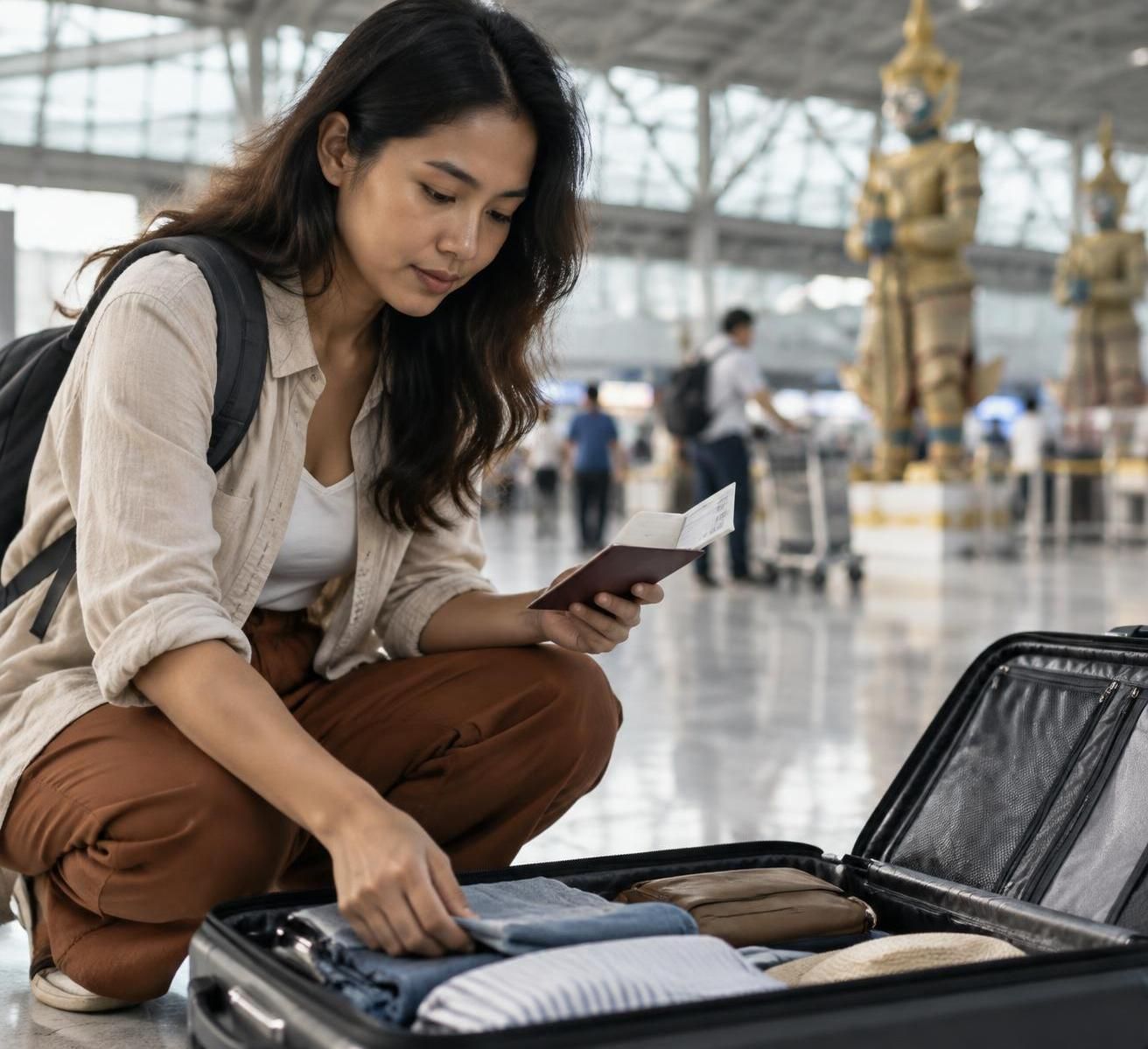
Keep power banks and spare lithium batteries in cabin baggage, subject to the capacity and quantity limits set by the airline and applicable aviation rules. Protect spare batteries from short circuits by leaving them in original packaging or placing them in individual protective sleeves or suitable containers.
Before leaving for the airport, check the rating printed on each battery. Airlines commonly express capacity in watt-hours; a power bank marked only in milliamp-hours may require additional information to determine its watt-hour rating.
For example, Maya carries a phone charger, a camera battery and a small power bank. She puts the loose batteries and the power bank in an accessible cabin bag, protects their contacts, and checks her carrier’s limits before she reaches the airport. If her cabin bag is taken at the gate for placement in the hold, she removes those items first.
Airline approval or stricter limits may apply to higher-capacity batteries, and some carriers restrict the use or charging of power banks during flight. Check the rules for every airline on the itinerary, including connecting flights, rather than assuming one carrier’s policy applies throughout.
Laptops, Cameras and Devices With Installed Batteries
Laptops, tablets, phones and cameras are generally best kept in the cabin. That makes them easier to present at screening and reduces the chance of damage, loss or difficulty reaching a device if its battery overheats.
Some devices with installed lithium batteries may be accepted in checked luggage under applicable rules, but they must be properly protected and switched off, not merely left in sleep mode. Airline instructions take precedence for the particular journey, and damaged or recalled batteries require special attention.
If a device has a removable battery, do not assume that placing the battery beside the device in a suitcase is acceptable. Once removed, it is a spare battery and should be carried and protected accordingly.
A Practical Baggage Placement Guide
| Item | Cabin baggage | Checked baggage |
|---|---|---|
| Power bank | Yes, subject to limits | No |
| Spare lithium battery | Yes, protected and subject to limits | No |
| Laptop or camera | Preferred | Sometimes permitted under airline rules |
| Essential medication | Preferred | Possible, subject to applicable rules |
| Vape or e-cigarette for entry into Thailand | Do not bring | Do not bring |
The table is a packing guide, not a substitute for an airline’s current dangerous-goods policy. A low-cost carrier, an international connection and a domestic Thai flight may have different operational requirements for otherwise similar bags.
Battery placement solves only one part of the security puzzle. Liquids, sharp objects and other everyday belongings need their own checks before a traveler reaches the screening lane.
Banned Items in Carry-On Luggage at Thai Airports
Some objects are legal to possess in Thailand but cannot pass through the passenger security checkpoint in a cabin bag. These banned items in carry-on luggage are assessed for aviation security, not simply for their value or their owner’s intentions.
A small knife used for preparing fruit at a hostel, for example, may seem harmless to its owner. At the checkpoint, however, it is treated as a sharp object that could threaten safety on board.
Sharp Objects, Tools and Sports Equipment
Knives, blades and many tools should not be carried into the cabin. Certain sharp objects and sporting equipment may be accepted in checked baggage if they are securely packed and the airline permits them, but that does not apply to every weapon or dangerous article.
Scissors, multipurpose tools and hiking equipment deserve particular attention because their treatment can depend on their design, dimensions and the screening authority’s rules. Check the departure airport’s requirements before deciding where to pack them.
Maya, for instance, has a compact multitool attached to her key ring. Removing it before the security queue gives her time to check whether it can travel in her checked bag; discovering it after that bag has already been handed over leaves fewer options.
Liquids, Gels and Aerosols
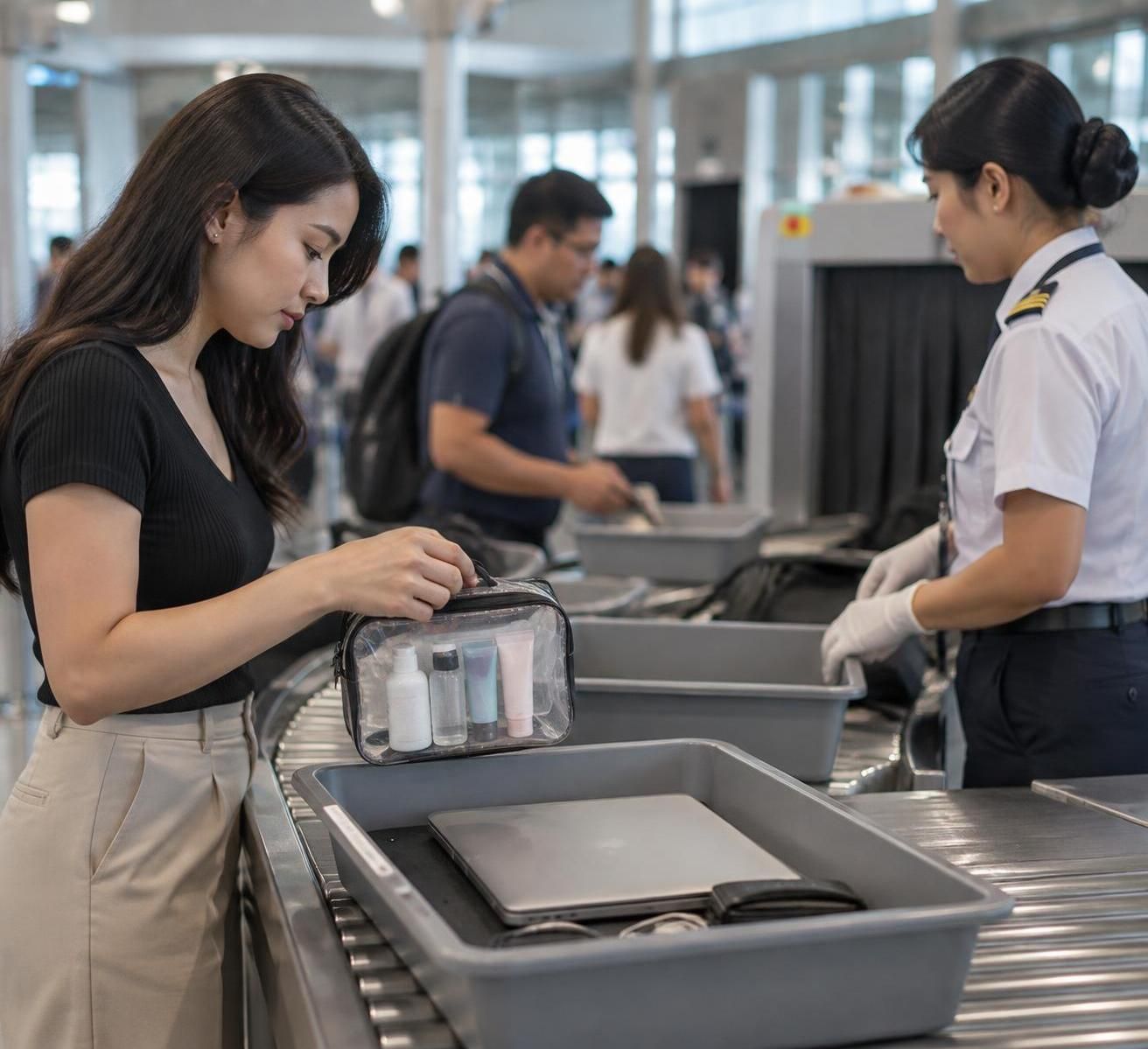
Cabin liquids are subject to screening restrictions. At many international checkpoints, the familiar rule is that containers must hold no more than 100 milliliters each and fit into a suitable transparent resealable bag, but travelers should verify the current requirements at their departure and transfer airports.
The container’s stated capacity matters, not just the amount left inside. A nearly empty 200-milliliter bottle may therefore be refused even if it contains only a small quantity of lotion.
Some medications, baby food and essential dietary products can be subject to exceptions and additional checks. Keep them accessible and bring supporting documentation where appropriate; a connecting airport may have different procedures from the first departure point.
Permitted toiletries can often go in checked baggage in larger containers, but aerosols and substances with flammable or corrosive properties remain subject to dangerous-goods limits. A product sold in an ordinary shop is not automatically safe to fly with.
Explosives, Fuel and Other Dangerous Materials
Fireworks, explosives, fuel and many flammable or corrosive substances are not ordinary packing problems: they are dangerous goods that may be prohibited in both cabin and checked baggage. Camping fuel is a useful example, because an apparently empty container can still contain hazardous residue.
Lighters, matches and personal-care aerosols have specific rules and exceptions that vary by item and carrier. Rather than treating all small containers alike, identify the substance and ask the airline before travel.
At screening, officers may require an item to be removed even if a traveler believes it should be allowed. Remaining calm and following instructions is usually the quickest way to resolve the immediate situation; if the item matters, ask what options are available before abandoning it.
These Thailand airport security rules protect the flight itself. The next checks concern whether food, medicine and other personal belongings are permitted to cross Thailand’s border.
Thai Customs Restrictions on Medication, Food and Plants
Personal medicines and familiar snacks can feel very different from commercial imports, yet both can be subject to Thai customs restrictions. The safest approach is to check the ingredients, quantity and purpose of the goods before departure, particularly when they contain controlled substances or animal and plant material.
How to Travel With Prescription Medication
Many travelers can travel with prescription medication for personal use, but not every medicine follows the same process. Certain narcotic or psychotropic medicines face specific controls, quantity limits or advance permit requirements, and some substances may not be permitted for import.
Check the active ingredients, not just the brand name. A medicine sold under one name in a traveler’s home country may be classified differently in Thailand, while a combination product can contain more than one controlled ingredient.
Carry medicines in their original labeled packaging when possible, together with a copy of the prescription or a doctor’s letter identifying the patient, medicine, dosage and medical purpose. Keep essential doses in the cabin so that they remain accessible during delays or if checked baggage arrives late.
Maya takes a prescription for an ongoing condition and also carries an over-the-counter sleep aid. Before departure, she checks both products with the Thai Food and Drug Administration, because the second item’s nonprescription status at home does not settle its status in Thailand.
If permission is required, arrange it in advance and keep the approval with the medication. Travelers should also check transit-country requirements: an itinerary can cross more than one legal border even when the passenger never leaves an airport.
Food, Supplements and Fresh Produce
Packaged snacks for personal consumption are not automatically treated the same way as meat, fresh fruit, seeds or supplements. Depending on the item and quantity, food products may require approval, inspection or other documentation.
Fresh plant material and animal products deserve particular care because they can carry pests or diseases. A sealed packet does not necessarily remove the need for a permit, especially when its contents include meat, seeds or ingredients from protected species.
Imagine a traveler bringing homemade dried meat as a gift for a friend in Bangkok. Even though the portion is small and intended for sharing, it may be subject to animal-health controls; checking the requirements before leaving home avoids an uncomfortable decision at the border.
Plants, Wildlife Products and Souvenirs
Plants, cuttings and seeds may require phytosanitary documentation or import permission. Products made from ivory, coral, shells or other wildlife can also be controlled under domestic rules and international wildlife-trade agreements.
Restrictions can matter on departure from Thailand as well as on arrival. A souvenir seller’s claim that an item is “airport safe” should not replace confirmation from the relevant authority, particularly when the material is difficult to identify.
When carrying goods that need to be declared or when their status is unclear, use the customs declaration process and ask an officer for guidance. Honest disclosure does not guarantee admission of an item, but it allows officials to assess it through the proper channel.
The practical insight is to treat documentation as part of the item itself. Once the contents are legal and correctly placed, the remaining task is to prepare for how airport staff may inspect the bag.
Thailand Baggage Screening Rules and Checked-Suitcase Inspections
A checked suitcase does not travel untouched simply because it has been locked. Security screening can identify an image that requires further inspection, and airport staff follow the applicable procedures for resolving the concern before a bag is loaded.
An inspection does not, by itself, prove that a passenger has done anything wrong. A dense object, an unfamiliar piece of equipment or an unclear scan can all prompt a closer look.
What Travelers Should Check About the October 2026 Procedures
New checked-baggage inspection procedures have been reported as scheduled to take effect on 16 October 2026, including circumstances in which officers could open a bag without its owner present. Travelers flying around or after that date should confirm the operative rules directly with their airport and airline before departure.
The important distinction is between a scheduled change and the procedure actually in force on the travel date. The details, including when a passenger is contacted, how an inspection is documented and whether a notice is placed inside the bag, should be checked against the current instructions.
A lock does not prevent an authorized security inspection. If staff need access and cannot open the lock normally, the lock or suitcase could be damaged in the process.
Choosing a Lock and Preparing for Inspection
A TSA-compatible lock is a practical option for checked baggage, not a general requirement for entry into Thailand. Such a lock can be opened without forcing it only when the inspecting personnel have access to the compatible system; travelers should not assume that every airport or officer has the necessary key.
Pack so that a security officer can identify unusual objects without having to unravel the entire suitcase. Keeping equipment in its case and avoiding tightly tangled cables can make the contents easier to assess.
Maya also photographs the outside of her suitcase and the more valuable contents before checking it. If the bag arrives damaged, those images give her useful information when speaking to the airline’s baggage desk; they do not, however, replace a formal report.
If a suitcase appears to have been opened on arrival, check for an inspection notice and examine the contents. Report missing property or damage to the airline’s baggage service promptly, keep the baggage tag and written report, and follow any deadlines set by the carrier.
Preparing Bags for a Smoother Airport Journey
Keep a passport, payment cards, essential medication and travel documents with the passenger rather than in the hold. A delayed checked bag is inconvenient; a delayed bag containing the documents needed to enter a country can be much harder to manage.
Label checked luggage with a reliable contact number and add a distinctive mark so that it is easier to identify on the carousel. Check the airline’s size and weight allowance for each flight, since a bag accepted on an international ticket may face different conditions on a separately booked domestic service.
Finally, review the latest baggage screening rules through the Civil Aviation Authority of Thailand, the relevant airport and the operating airline. A few minutes spent checking the actual itinerary can prevent a rushed decision at the counter, particularly when a bag changes hands or a flight connection crosses another jurisdiction.