
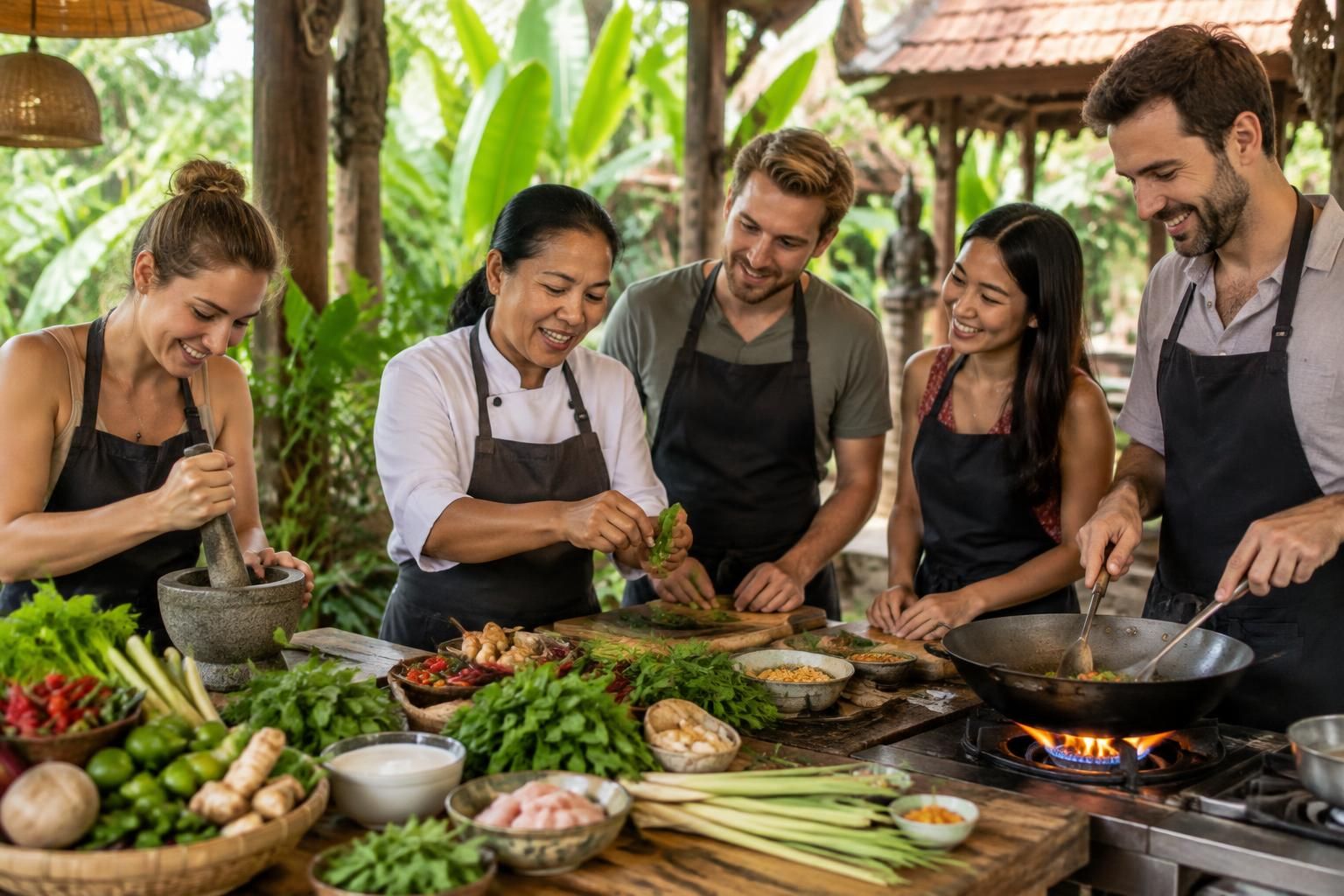
A bowl of tom yum or a plate of pad thai can become much more interesting when the person enjoying it understands how its flavors are built. A cooking class in Thailand offers that change of perspective: a chance to explore unfamiliar produce, prepare a meal alongside others and discover the care behind dishes encountered throughout a trip.
For a traveler navigating night buses, busy markets and a constantly changing itinerary, a few hours in a kitchen can also be a welcome pause. Classes range from city sessions near a morning market to farm visits outside Chiang Mai, with options for beginners as well as confident home cooks. Most provide a generous meal, practical guidance and recipes to take away, though menus, prices and group sizes vary.
The appeal lasts beyond the journey. Knowing how to balance lime, chili, sweetness and savory seasonings makes it easier to bring a little of the experience into a kitchen at home. For a clearer picture of what to expect, imagine Alex, a first-time visitor deciding where to book and what to learn.
At a glance
- A Thai cooking class combines a meal, a social activity and practical skills that travelers can use again.
- Many sessions include a market visit and several dishes, although the exact itinerary depends on the school.
- Chiang Mai, Bangkok and popular coastal destinations offer different settings and schedules.
- Check recent reviews, dietary arrangements, group size and what is included before booking.
- Expect to learn techniques that can be adapted at home, even when some ingredients are difficult to find.
Why a Thai Cooking Class Makes Food Culture More Personal
Eating well is easy in Thailand, but understanding what makes a dish taste the way it does takes a little more attention. A guided kitchen session gives travelers time to ask questions that might be difficult to explore while ordering from a busy street food stall.
Take a bowl of tom yum. Its bright, sharp flavor is not simply the result of adding more chili: fragrant herbs, sour lime and savory seasoning each contribute something different. When an instructor explains those roles, a familiar soup becomes a useful lesson in how Thai cuisine balances contrasting flavors.
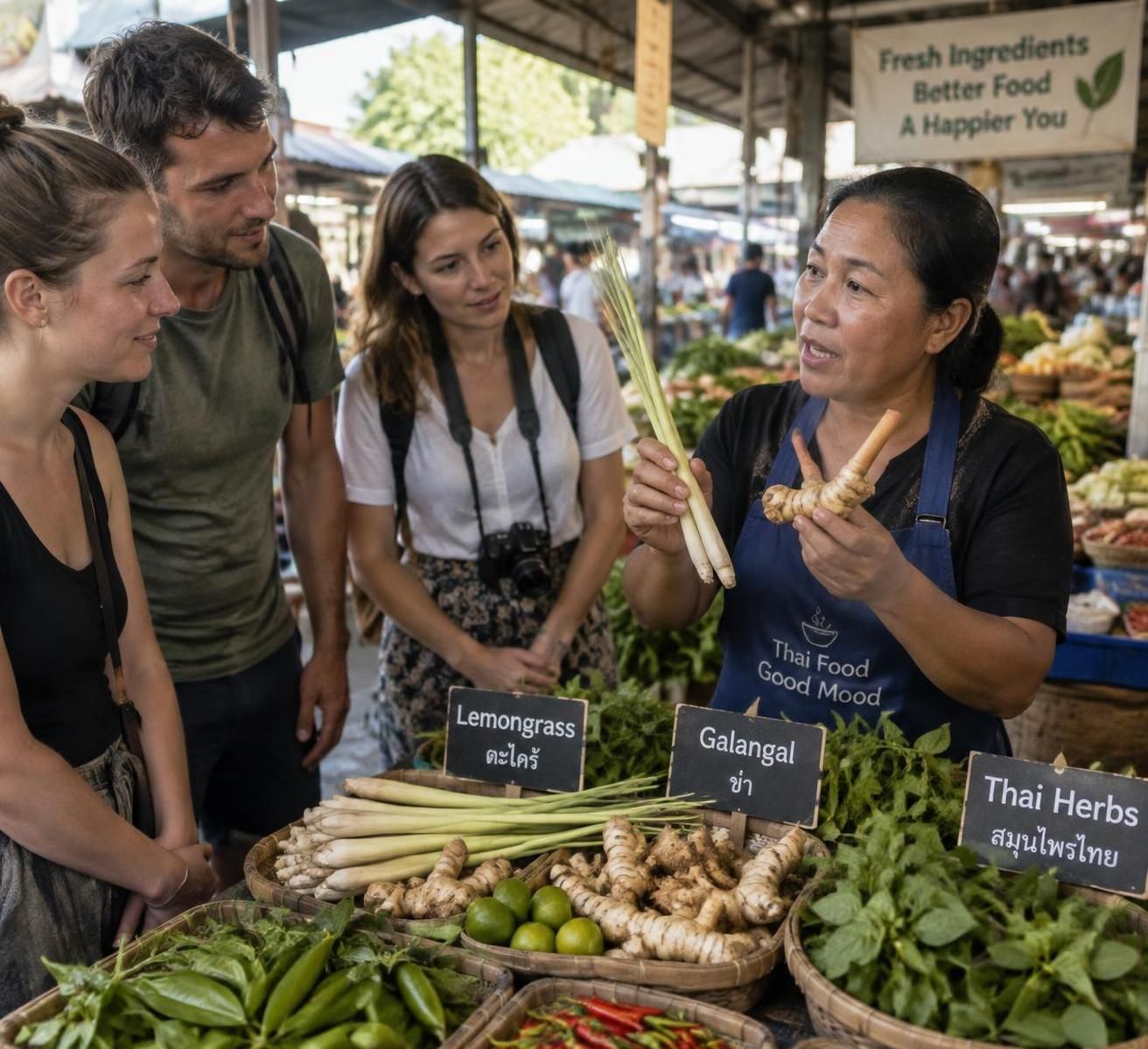
For Alex, the appeal begins with a market visit. A seller’s table may hold several varieties of eggplant, bundles of lemongrass and leaves that look unfamiliar. With a guide nearby, the produce becomes less intimidating: there is time to touch, smell and ask how each item is used.
Discover Local Ingredients Beyond the Menu
Many dishes depend on aromatic roots and herbs that do more than add heat. Galangal brings a distinctive citrusy, peppery note, while lemongrass lends freshness and makrut lime leaves contribute an intense fragrance. These ingredients are often added to soups or curries for flavor rather than eaten whole.
A class can also reveal how seasonings change from one dish to another. Fish sauce provides saltiness and depth, palm sugar adds sweetness, and lime juice contributes acidity. The lesson is not that every plate must contain identical amounts of each, but that tasting helps the cook decide what the dish needs.
That distinction matters because food culture is lived and varied, not a single formula. Recipes differ between households, regions and individual cooks. An instructor may share a family approach or a version designed for a mixed group, offering one useful perspective rather than a definitive account of every Thai kitchen.
Connect With People Through Hands-On Cooking
There is another reason travelers remember these sessions: they make meeting people feel natural. Sharing a mortar, comparing curry pastes or laughing over an unexpectedly fiery spoonful gives solo travelers an easy conversation starter without the pressure of a formal social event.
Beginners are welcome in many kitchens, and a supportive teacher can make a nervous cook feel comfortable. Alex might arrive worried about knife skills and leave having prepared a meal with guidance, discovering that curiosity matters more than prior experience.
For couples, friends or families, the shared task offers a different rhythm from sightseeing. Instead of rushing between attractions, everyone contributes to something tangible and then sits down to enjoy it. Children’s participation rules vary, so families should confirm age limits before reserving.
A well-run culinary experience also encourages attention to the people behind a destination’s food. Asking respectful questions about ingredients, preparation and family traditions makes a meal feel less like a checklist item and more like an exchange. That curiosity naturally leads to the practical question of what actually happens once the aprons go on.
What to Expect From a Cooking Class in Thailand
Most classes follow a straightforward rhythm: an introduction to ingredients, a period of preparation and cooking, and time to eat. Some last half a day, while others take a full day or include transport to a farm. The number of dishes, the pace and the order of activities depend on the operator.
Alex’s hypothetical session starts at a neighborhood market, where the instructor identifies vegetables, herbs, curry pastes and different kinds of rice. This is a chance to understand what goes into a dish before encountering those ingredients chopped and ready on a worktop.
Not every school includes a market stop, and some arrange a garden walk instead. Both can be worthwhile: a market shows how ingredients are sold and selected, while a garden allows participants to see how herbs and vegetables grow. Travelers with limited time may prefer a kitchen-only session closer to their accommodation.
From Curry Paste to a Shared Meal
Back at the kitchen, participants may make a curry, a stir-fry, a soup, a salad and a dessert. A typical menu might include green curry, pad thai, tom yum, som tum and mango sticky rice, although schools often offer a smaller selection or allow guests to choose between alternatives.
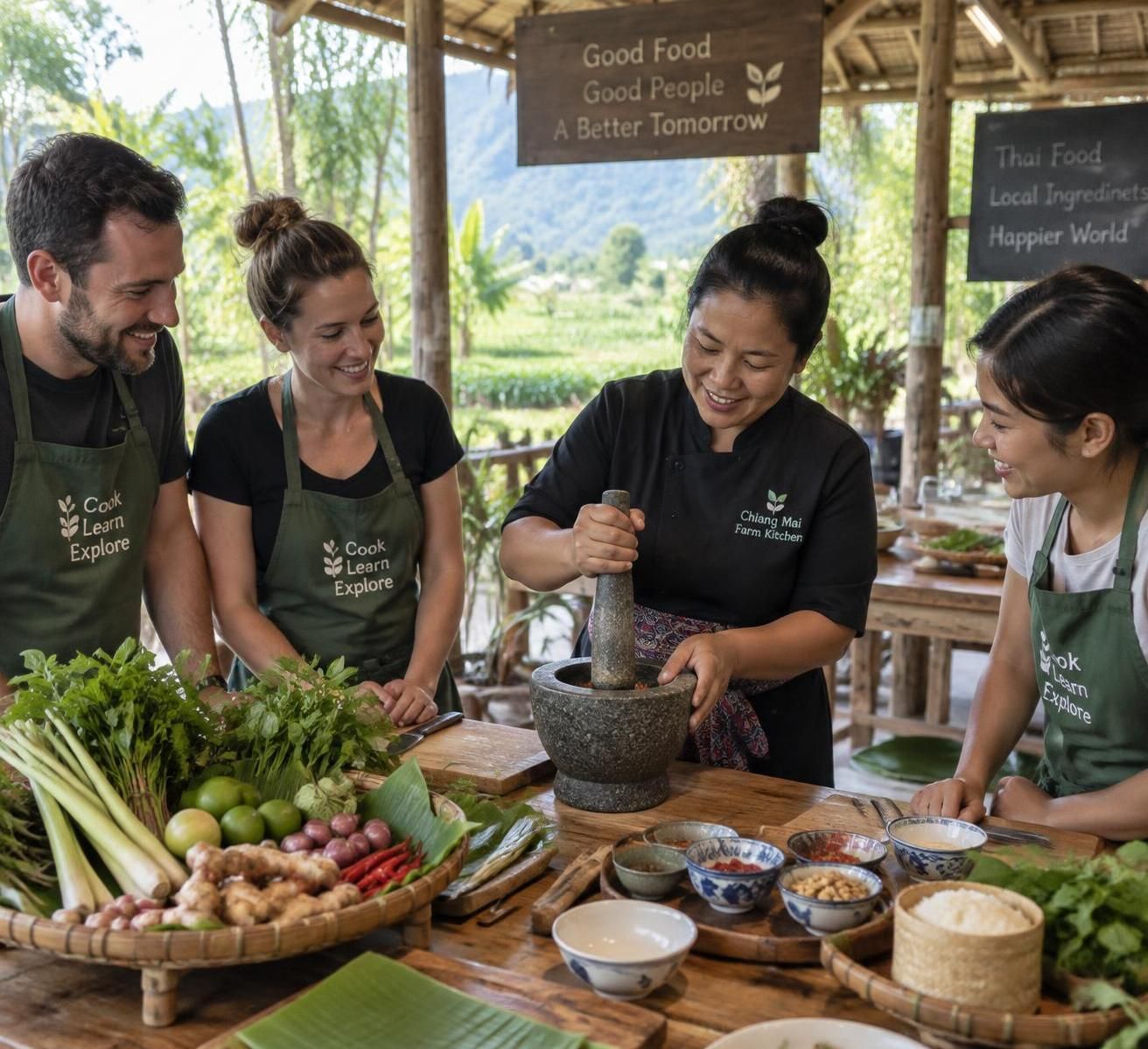
Preparing curry paste is especially memorable when it involves a mortar and pestle. Pounding aromatics into a fragrant mixture takes patience, and the instructor can explain why ingredients need to be cut into manageable pieces before they go in. Some classes use prepared paste instead, so travelers keen to learn this step should check the description.
A stir-fry demonstrates a different skill: timing. Ingredients are usually prepared before the pan gets hot, because cooking can move quickly once the oil is ready. Watching an instructor first, then trying the method at an individual station, makes the sequence easier to understand.
Participants commonly eat dishes as they are finished or share them at the end. Portions and serving arrangements vary, but the food often amounts to a substantial meal. It is sensible to arrive hungry without skipping water, particularly in hot weather.
Make the Most of Your Time at the Stove
Questions are part of the value. Alex might ask whether a chili is used for flavor or heat, why a soup is seasoned at a particular stage, or how to recognize when a curry paste has cooked sufficiently. Those answers are often more useful later than a photograph of the finished plate.
Comfort matters too. Closed-toe shoes, tied-back hair and clothes that can handle a splash of oil make the experience easier. Travelers who use mobility aids or need seating during preparation should ask about the kitchen layout and market route before booking.
Many providers give guests a printed or digital recipe booklet, though it is worth confirming. A recipe supports the learning, but the most valuable details are often the sensory cues: how a paste smells, how a sauce looks and what a balanced spoonful tastes like.
Understanding the schedule makes it easier to choose a session that feels enjoyable rather than rushed. The next decision is where in Thailand that session will fit best.
Where to Take a Thai Cooking Class: Chiang Mai, Bangkok or the Islands
There is no single best setting for every traveler. A city kitchen may suit someone with a short stopover, while a rural school can turn the activity into a slower day outside town. Coastal options add another possibility for travelers whose itinerary is built around beaches and island hopping.
For Alex, the decision comes down to available time rather than a search for the supposedly perfect school. A class that fits comfortably between travel days leaves more energy for learning than an ambitious booking squeezed between a late arrival and an early departure.
Chiang Mai Cooking Classes and Farm Settings
Chiang Mai has a wide choice of schools, including operations that take guests to farms outside the city. Some combine a garden walk with cooking stations in an open-air setting, making the journey itself part of the day. Others operate closer to the center and are easier to reach independently.
A farm visit can be appealing to anyone interested in seeing herbs before they reach a market stall. It also offers a quieter contrast to the old city’s traffic and busy streets. Check whether transfers are included, how long the drive takes and whether the schedule leaves time for other plans.
Northern Thailand has its own food traditions, so the menu deserves attention. A school may offer regional specialties alongside dishes familiar from restaurants elsewhere. Choosing a class that explains those differences gives travelers more context than assuming that one menu represents the entire country.
Bangkok Kitchens and Coastal Experiences
Bangkok suits travelers who want to combine a lesson with a dense urban itinerary. Schools range from relaxed market-based workshops to more polished culinary studios. A central location can make it possible to cook in the morning and explore another neighborhood later without losing much time in transit.
Traffic can still affect the day. Alex checks the actual meeting point rather than relying on a broad neighborhood name, then considers public transport or allows a generous buffer for a road journey. An included pickup is useful only when its route and timing work with the rest of the itinerary.
In Phuket, Krabi and Koh Samui, travelers can find classes at dedicated schools, hotels and resorts. The setting may be especially attractive for a holiday with limited inland travel, though the view alone should not replace questions about the menu and how much individual cooking is involved.
| Destination | Appeal | Practical point to check |
|---|---|---|
| Chiang Mai | Farm settings and a broad choice of schools | Transfer time and whether a garden visit is included |
| Bangkok | Convenient city sessions and market visits | Meeting point and travel time across the city |
| Phuket, Krabi and Koh Samui | Classes that fit into a coastal itinerary | Transport, group size and actual hands-on time |
Each location can provide a rewarding lesson; the setting is only one part of the decision. Once Alex has chosen a destination, the details of the individual booking become much more important.
How to Choose a Thai Cooking Class That Is Worth the Money
A good class is not necessarily the most expensive or the one with the longest menu. It is the one that gives participants enough guidance and practical time to enjoy what they are learning. Before paying, Alex compares several options using the same questions rather than choosing on photographs alone.
Start with the menu. If making curry paste is a priority, check that participants actually prepare it rather than simply watching a demonstration. If mango sticky rice or a particular regional dish is the reason for booking, confirm that it is available on the chosen day.
Some schools let each guest select dishes, while others teach everyone the same set. Choice can make the meal more appealing, but a fixed menu may allow the instructor to keep the group moving together. Neither approach is automatically better; what matters is knowing which one is offered.
Compare Reviews, Group Size and Inclusions
Recent reviews can reveal details that a short advertisement misses. Look for comments about whether the teacher answers questions, whether guests cook individually and whether the kitchen feels organized. A consistent pattern across several reviews is more useful than one unusually enthusiastic or disappointed account.
Group size also affects the experience. In a smaller group, participants may find it easier to see demonstrations and ask for help. A larger class can still work well when there are enough instructors and cooking stations, so ask how the school organizes practical work rather than relying on the headcount alone.
As a broad planning guide, many traveler-oriented classes are advertised around ฿1,000–฿2,500, but prices vary with location, duration, transfers and the type of venue. Treat the range as a starting point, not a guarantee, and check the current listing before making a reservation.
A cheaper option may exclude transport or a market tour; a higher-priced one may include a longer excursion or a smaller group. Compare the full package, including drinks, recipes and any extra charges. Travelers budgeting in another currency should use a current exchange-rate converter rather than relying on a fixed conversion.
Ask About Dietary Needs Before Paying
Vegetarian travelers should ask what substitutions are used, not just whether a dish can be described as vegetarian. Fish sauce, shrimp paste and oyster sauce can appear in dishes that otherwise contain plenty of vegetables. A school that understands the request can explain its alternatives clearly.
Allergies require a more detailed conversation. Ask whether the kitchen can avoid the relevant ingredient and how it handles shared equipment, oils and preparation surfaces. For a severe allergy, the ability to manage cross-contact matters as much as the stated menu.
Accessibility, children’s participation, cancellation terms and pickup locations are also worth checking directly. For example, a farm kitchen reached by steps or an uneven garden path may not suit every guest, while a city studio may be easier to reach.
Alex sends a short message listing the essential questions and keeps the reply with the booking confirmation. A clear response makes it easier to arrive relaxed, ready to focus on the skills that will still be useful after the holiday.
Thai Cooking Skills You Can Take Home After Your Trip
The strongest reason to book a lesson may become apparent weeks later, when the holiday is over and dinner needs to be made. A recipe booklet can help, but the real souvenir is the confidence to taste, adjust and understand why a dish works.
Imagine Alex back home, looking at a recipe for a coconut curry. Instead of treating every ingredient as mysterious, Alex remembers the aroma of the paste, the way the instructor added liquid and the importance of tasting before serving. The result may differ from the meal in Thailand, but the process now has a clear starting point.
Learn to Balance Thai Flavors With Confidence
A useful first principle is to season gradually. Sweetness, sourness, saltiness and chili heat interact, but their balance depends on the dish and the cook’s preference. Adding a small amount, tasting and adjusting is more reliable than trying to repair a heavily seasoned pan at the end.
For example, a soup that tastes flat may need acidity rather than more salt. A sauce that feels too sharp might benefit from a little sweetness, while a curry that lacks depth may need more time cooking its paste. These are observations to test carefully, not universal fixes.
The lesson also makes Thai spices and aromatics easier to handle. Crushing lemongrass can release fragrance into a broth, while finely preparing it may be appropriate when it forms part of a paste. Knowing whether an ingredient is intended to be eaten or simply to flavor the dish helps avoid an unpleasant mouthful.
Preparing ingredients before heating the pan is another habit that travels well. A quick stir-fry leaves little time to search for a sauce or chop vegetables. Setting everything within reach makes the cooking calmer and reduces the chance of overcooking.
Find Ingredients and Adapt Traditional Recipes Thoughtfully
Availability varies outside Thailand, so a visit to an Asian grocery can become part of the next cooking adventure. Fresh herbs, curry pastes, rice noodles and seasonings may be stocked there, while frozen or dried products can sometimes offer practical alternatives. Ask the instructor which substitutions work for the dishes taught in class.
Substitution is not always a one-to-one exchange. Ginger and galangal, for instance, have different flavors even though both are aromatic rhizomes. A replacement can make a pleasant meal, but recognizing the difference helps set expectations rather than assuming the result will taste identical.
Ready-made curry paste can be useful on a busy evening, especially after learning what goes into it. Alex can start with a modest amount, follow the package guidance and adjust the finished dish. Cooking from scratch remains an option when there is more time and the necessary ingredients are available.
Traditional recipes become easier to revisit when notes include more than measurements. Alongside the ingredient list, record details such as when the paste smelled fragrant, whether the dish was served with rice and which seasoning the teacher added last. These observations preserve the practical knowledge that a standard recipe may leave out.
The travel experience can continue around a shared table too. Preparing one dish for friends creates an opportunity to talk about the market, the instructor and the flavors encountered on the journey, while acknowledging that one class offers a glimpse of a much broader culinary tradition.
The lasting skill is not perfect reproduction; it is knowing how to cook with attention. Each time Alex tastes a sauce and adjusts it deliberately, the lesson has a place in everyday life.